
Common Tajweed Mistakes Beginners Make are among the main challenges that many new learners face when they start their journey of reading the Quran correctly. Learning Tajweed is not only about memorizing rules; it is about understanding how every Arabic letter should be pronounced, where each sound comes from, and how Quranic words should be recited with accuracy and respect.
Many beginners feel that reading the Quran becomes difficult because Arabic pronunciation is different from their native language. Some letters have unique sounds, some rules require controlling the length of pronunciation, and others need special attention to the movement of the tongue and mouth. However, with proper guidance, regular practice, and a clear learning plan, anyone can improve their Quran recitation.
Tajweed provides a structured method that helps learners avoid pronunciation mistakes and develop confidence while reading the Quran. Whether a person is starting from the Arabic alphabet or already reading short Surahs, understanding frequent mistakes is an important step toward better recitation.
For students who need organized lessons and professional guidance, Sana Online Quran Academy provides online Quran education designed to help learners improve their reading skills, understand Tajweed rules, and practice Quran recitation according to their level.
What Is Tajweed and Why Is It Important for Quran Reading?

Tajweed is the science of reading the Quran with the correct pronunciation and applying the rules that protect the original sounds of Arabic letters. The word Tajweed means improvement or making something better. In Quranic studies, it refers to giving every letter its correct rights and characteristics.
When beginners start learning the quran with tajweed course, they may focus mainly on recognizing words and reading verses. However, correct pronunciation is essential because changing the sound of a letter can sometimes affect the meaning of a word.
Tajweed focuses on several important areas, including:
- Makharij Al-Huruf (articulation points): Understanding where each letter comes from.
- Sifaat Al-Huruf (letter characteristics): Learning the qualities that distinguish letters.
- Madd rules: Knowing when and how long to stretch sounds.
- Ghunnah: Applying the correct nasal sound.
- Qalqalah: Producing the correct echoing sound for specific letters.
- Noon Sakinah and Tanween rules: Applying Izhar, Idgham, Iqlab, and Ikhfa.
- Meem Sakinah rules: Understanding how the letter Meem is pronounced in different situations.
A strong foundation in these areas helps learners read smoothly and avoid mistakes that may become difficult to correct later.
Start Your Quran Learning Journey Today with Sana Online Quran Academy
Start your Quran learning journey today with Sana Online Quran Academy, where structured and simple programs are designed for both children and adults. In fact, lessons are delivered step by step by qualified teachers who focus on reading skills, basic Tajweed, and gradual improvement with clear explanations.
In addition, you can study from home with flexible schedules that fit your daily routine. Moreover, regular practice and feedback help you improve steadily. As a result, learning becomes easier, more consistent, and more effective.

Why Do Beginners Make Common Tajweed Mistakes Beginners Make While Learning Quran?
Many beginners make mistakes because Quranic Arabic contains sounds that may not exist in their first language. A learner who speaks English, French, or another language may find some Arabic letters challenging because the tongue position and pronunciation method are unfamiliar.
Another reason is learning without enough correction. Reading the Quran silently or practicing alone can help build familiarity, but pronunciation mistakes may continue if no one identifies them.
Some common reasons include:
- Learning letters without focusing on their correct sounds.
- Reading too quickly before mastering pronunciation.
- Depending only on transliteration.
- Memorizing Tajweed rules without applying them.
- Not practicing regularly.
- Listening to Quran recitation without repeating.
Understanding these causes allows learners to create better habits from the beginning.
1. Common Tajweed Mistakes Beginners Make in Arabic Letter Pronunciation
One of the biggest challenges for beginners is pronouncing Arabic letters from the correct articulation point. This is one of the most important areas when discussing Common Tajweed Mistakes Beginners Make because every Quranic word is built from individual letters.
Some Arabic letters look similar but have completely different sounds. For example:
- ق (Qaaf) and ك (Kaaf)
- ص (Saad) and س (Seen)
- ط (Taa) and ت (Taa)
- ح (Haa) and ه (Haa)
- ض (Daad) and other similar sounds
A learner may replace one letter with another because both sounds appear close. However, why Tajweed Is Important in Quran Reading requires recognizing the difference between them.
How to Correct Letter Pronunciation
Beginners should avoid trying to read complete pages immediately. Instead, they should follow a gradual approach:
- Learn each Arabic letter separately.
- Understand where the sound comes from.
- Practice the letter with different vowel marks.
- Read simple words containing that letter.
- Apply the pronunciation while reading Quranic verses.
Repeating difficult letters every day for a few minutes can create significant improvement over time.
2. Common Tajweed Mistakes Beginners Make With Heavy and Light Letters
Arabic letters are divided into heavy and light categories. Some letters are pronounced with a stronger, deeper sound, while others have a lighter pronunciation.
The heavy letters are:
خ ص ض غ ط ق ظ
A common beginner problem is reading heavy letters like light letters. For example, some learners pronounce ص like س, or ط like ت.
This mistake usually happens because the learner focuses only on the written shape of the letter and does not practice the correct mouth position.
To improve:
- Listen carefully to skilled Quran reciters.
- Repeat the sound slowly.
- Pay attention to tongue placement.
- Practice words containing heavy letters.
Learning these differences early prevents repeated mistakes in Quran reading.
3. Common Tajweed Mistakes Beginners Make When Ignoring Harakat and Short Vowels
Harakat are the vowel signs placed above or below Arabic letters. They guide the reader on how each letter should sound.
The three basic Harakat are:
- Fathah (َ ) produces an “a” sound.
- Kasrah (ِ ) produces an “i” sound.
- Dammah (ُ ) produces an “u” sound.
Many beginners try to recognize Arabic words without paying enough attention to Harakat. This can lead to incorrect pronunciation.
For example, the same Arabic letter can produce different sounds depending on its vowel mark.
A good learning method is to practice:
- Individual letters with Harakat.
- Two-letter combinations.
- Short words.
- Quranic examples.
Students at Sana Online Quran Academy often begin with these foundations because mastering basic reading skills makes advanced Tajweed lessons easier.
4. How Reading Too Quickly Creates Common Tajweed Mistakes Beginners Make
Another frequent problem among beginners is rushing through verses. Some learners believe that faster reading means better progress, but speed without accuracy can create many pronunciation problems.
Reading too quickly may cause:
- Missing letters.
- Ignoring Tajweed rules.
- Incorrect stretching.
- Weak pronunciation.
- Skipping pauses.
The goal of Quran recitation is not speed; it is correctness, clarity, and reflection.
Beginners should follow this principle:
Accuracy comes before speed.
A learner who reads slowly with correct pronunciation will naturally become faster with consistent practice.
5. Common Tajweed Mistakes Beginners Make in Madd Rules Application
Madd means extending or lengthening a sound. It is an important part of Quran recitation because some letters require specific periods of stretching.
A common mistake is making Madd too short or too long.
For example, some beginners:
- Stretch sounds that should not be extended.
- Do not stretch letters that require Madd.
- Apply the same length to all Madd types.
Learning Madd requires both theoretical knowledge and listening practice.
The Best Online Tajweed Classes approach is:
- Learn the rule.
- Listen to examples.
- Repeat after a qualified reciter.
- Apply it while reading.
With regular practice, learners develop a natural sense of correct timing.
6. Missing Ghunnah and Qalqalah in Quran Recitation
Among the important topics related to Common Tajweed Mistakes Beginners Make is ignoring Ghunnah and Qalqalah rules. Many learners memorize the definitions of these rules but find it difficult to recognize when and how they should be applied while reading the Quran.
Understanding Ghunnah Correctly
Ghunnah is a nasal sound that appears mainly with the letters Noon (ن) and Meem (م) in specific situations. It requires producing the sound through the nose with a balanced pronunciation.
A common mistake is:
- Removing the nasal sound completely.
- Making the Ghunnah too long.
- Making it too weak.
- Applying it where it is not required.
For example, when Noon or Meem has a Shaddah, the reader needs to give proper attention to the Ghunnah duration.
Understanding Qalqalah Rules
Qalqalah refers to a slight echoing sound that occurs with five letters:
ق – ط – ب – ج – د
These letters are called the Qalqalah letters. The sound appears when one of these letters has a Sukoon.
Beginners often make two mistakes:
- Making the Qalqalah sound too strong.
- Not producing the echo sound at all.
The correct method is to create a clear but controlled bounce without adding extra movement to the letter.
To improve these skills, learners should listen carefully to accurate Quran recitation and repeat after experienced reciters. Practicing individual words before reading complete verses makes correction easier.
7. Confusing Noon Sakinah and Tanween Rules
One of the most common challenges in Tajweed learning is applying the rules of Noon Sakinah and Tanween correctly. These rules require understanding how the letter Noon changes depending on the letter that follows it.
The four main rules are:
Izhar (Clear Pronunciation)
Izhar means pronouncing Noon Sakinah or Tanween clearly without merging or hiding the sound.
Idgham (Merging)
Idgham means combining the Noon sound with the following letter in certain cases.
Iqlab (Changing)
Iqlab occurs when Noon Sakinah or Tanween comes before the letter ب, causing the Noon sound to change into a hidden Meem sound.
Ikhfa (Hiding)
Ikhfa means partially hiding the Noon sound while maintaining Ghunnah. Many beginners know the names of these rules but cannot identify them while reading. This happens because they study Tajweed as information instead of applying it practically.
A better learning method is:
- Learn Tajweed online, each rule separately.
- Memorize its letters.
- Practice with Quranic examples.
- Ask for correction while reading.
This approach helps transform Tajweed from theory into a natural reading skill.
8. Incorrect Application of Meem Sakinah Rules
Another area where beginners experience difficulty is Meem Sakinah. Similar to Noon Sakinah and Tanween, Meem Sakinah has specific rules that control pronunciation.
The three main rules are:
- Ikhfa Shafawi
- Idgham Shafawi
- Izhar Shafawi
The mistake happens when learners pronounce every Meem in the same way without considering the following letter.
For example, Meem before ب requires a special hidden pronunciation, while Meem before another Meem requires merging.
Regular practice with Quranic examples helps learners recognize these situations naturally. Students who study through Sana Online Quran Academy can benefit from structured Tajweed lessons where rules are introduced gradually and practiced through actual Quran reading.
9. Stopping and Starting at the Wrong Places
Correct Quran recitation is not only about pronunciation. Knowing where to stop and where to continue is also an important part of Tajweed.
Many beginners stop whenever they need to breathe without considering the meaning of the verse. Sometimes an incorrect stopping place can affect the understanding of the sentence.
The rules of stopping and beginning, known as Waqf and Ibtida, help readers know:
- Where a complete meaning ends.
- Where stopping is appropriate.
- Where continuing is better.
- How to restart after a pause.
Beginners should practice reading with attention to the meaning, not only the words. A good habit is to listen to experienced reciters and notice their stopping points.
10. Depending Too Much on Transliteration
Transliteration can be useful for beginners, especially during the first stages of learning Arabic letters. However, depending on it for a long time can slow Quran reading improvement. English or other language letters cannot represent all Arabic sounds accurately.
For example, some Arabic letters require special pronunciation positions that cannot be fully explained through English spelling.
A learner who depends only on transliteration may struggle with:
- Correct letter sounds.
- Heavy and light letters.
- Accurate Madd.
- Proper articulation points.
The best approach is to use transliteration only as temporary support while gradually moving toward reading directly from the Arabic Quran.
How to Avoid Common Tajweed Mistakes Beginners Make During Quran Recitation?
Avoiding mistakes requires more than memorizing rules. Tajweed improves through continuous practice and correction.
Here are practical steps that help beginners develop better Quran recitation:
1. Start With Strong Foundations
Before learning advanced rules, make sure you understand:
- Arabic letters.
- Letter pronunciation.
- Harakat.
- Basic reading skills.
A weak foundation often creates repeated mistakes later.
2. Practice Every Day
Short daily practice is more effective than studying for many hours once a week.
A simple routine can include:
- Five minutes reviewing letters.
- Ten minutes reading Quran.
- Five minutes listening and repeating.
Consistency builds confidence.
3. Listen Before Reading
Listening is an important part of learning Tajweed. Before reading a new Surah, listen to correct recitation several times.
This helps you understand:
- Pronunciation.
- Rhythm.
- Pauses.
- Madd timing.
4. Record Your Recitation
Recording yourself is a useful method because many mistakes are difficult to notice while reading.
After recording:
- Compare your pronunciation with correct recitation.
- Identify difficult words.
- Repeat them several times.
5. Learn From Qualified Guidance
Self-learning has benefits, but pronunciation correction often requires someone who can hear mistakes and explain how to fix them.
A structured learning environment helps beginners avoid building incorrect habits.
Sana Online Quran Academy focuses on helping students learn Quran reading step by step, practice Tajweed rules, and receive guidance according to their individual level.
How Sana Online Quran Academy Helps Beginners Improve Tajweed?

Learning Quran online has become a convenient option for students who need flexible schedules and organized lessons. Sana Online Quran Academy offers a learning approach that supports beginners who want to improve Quran reading and Tajweed skills from home.
The learning process can include:
- Basic Quran reading lessons.
- Arabic pronunciation practice.
- Tajweed rule explanation.
- Verse-by-verse correction.
- Regular progress evaluation.
One advantage of online learning is that students can practice without needing to travel. This makes Quran education accessible for children, adults, and busy learners.
A beginner does not need to master every Tajweed rule immediately. A gradual approach helps learners build confidence while improving their pronunciation step by step.
A Practical Daily Plan to Improve Quran Recitation
Many beginners ask how much time they should spend practicing Tajweed. The answer depends on their level, but regular practice is always important.
A simple daily plan:
- First 5 Minutes: Review Previous Mistakes. Read difficult letters or verses that required correction before.
- Next 10 Minutes: Read New Quran Verses. Focus on accuracy instead of speed.
- Next 5 Minutes: Listen and Repeat. Listen to a skilled reciter and repeat the same verses.
- Final Minutes: Practice One Tajweed Rule. Choose one rule and apply it during reading. This method creates steady improvement without making learning stressful.
How to Fix Common Tajweed Mistakes Beginners Make With Daily Practice?
Improving Quran recitation requires patience, consistency, and a clear learning strategy. Although many students understand Tajweed rules theoretically, they may still struggle when applying them during actual Quran reading. Therefore, the best way to improve is to combine knowledge, listening, repetition, and correction.
First of all, beginners should understand that mistakes are a natural part of learning. However, ignoring mistakes for a long time can make them become difficult habits. For this reason, early correction and regular practice are essential for achieving accurate Quran recitation.
Moreover, every learner has different challenges. Some students struggle with Arabic letters, while others need more practice with Madd, Ghunnah, or stopping rules. Therefore, identifying personal weaknesses is an important step toward improvement.
Common Tajweed Mistakes Beginners Make When Learning Tajweed Without Guidance
One of the reasons learners continue making pronunciation errors is trying to study Tajweed completely alone. While online resources and videos can provide useful information, they cannot always identify personal pronunciation problems.
For example, a student may believe that a certain letter is pronounced correctly, but a qualified instructor can notice small differences in tongue position or sound quality.
Additionally, Tajweed is a practical science. It is not enough to memorize definitions such as:
- What is Idgham?
- What is Qalqalah?
- What are the letters of Ikhfa?
Instead, learners must know how to recognize and apply these rules while reading Quranic verses.
Therefore, receiving feedback during practice helps students correct mistakes before they become permanent.
How Does Listening Help Reduce Common Tajweed Mistakes Beginners Make?
Listening is one of the most powerful methods for reducing Common Tajweed Mistakes Beginners Make. Before trying to read a new Surah, beginners should listen carefully to accurate recitation.
This method helps learners understand:
- Correct pronunciation of Arabic letters.
- Proper Madd duration.
- Natural rhythm of Quran recitation.
- Correct stopping places.
- Application of Tajweed rules.
Furthermore, repeating after a skilled reciter creates a connection between hearing and speaking. Over time, learners begin to recognize correct sounds more naturally.
However, listening alone is not enough. Although it improves awareness, students still need active practice and correction.
How Slow Quran Reading Prevents Common Tajweed Mistakes Beginners Make?
Many beginners think that fluent Quran reading means reading quickly. However, speed should never be the main goal during the early stages of learning.
Instead, slow reading allows learners to focus on:
- Every letter.
- Every vowel mark.
- Every Tajweed rule.
- Every pronunciation detail.
For instance, when practicing a verse slowly, a student can notice whether a letter is heavy or light, whether Madd is correct, and whether Ghunnah is applied properly.
Consequently, slow and careful reading creates a strong foundation. Later, when accuracy improves, reading speed will increase naturally.
Using Technology to Fix Common Tajweed Mistakes Beginners Make Effectively
Technology has changed the way people learn Quran. Today, students can use digital tools to support their learning journey and practice Quran recitation more conveniently.
However, technology should be used correctly. It should support learning rather than replace proper education.
Useful learning tools may include:
- Quran reading applications.
- Audio recitation libraries.
- Tajweed practice exercises.
- Online lessons.
- Progress tracking systems.
For example, Sana Online Quran Academy combines online learning methods with structured Quran lessons to help students practice reading and improve their Tajweed skills from home.
Furthermore, online learning gives students the flexibility to study according to their own schedule. Therefore, it can be especially helpful for children, working adults, and busy families.
Why Regular Feedback Is Important for Learning Tajweed Correctly?
Feedback plays a major role in Quran learning. Without correction, beginners may repeat the same errors for months without realizing them.
A good learning process includes:
- Reading Quran aloud.
- Receiving corrections.
- Understanding the reason behind the mistake.
- Practicing the correct pronunciation.
- Applying the improvement in future reading.
In addition, positive feedback encourages students and increases their confidence.
A learner should not feel discouraged because of mistakes. Instead, every correction is an opportunity to improve.
Common Tajweed Mistakes Beginners Make During Children’s Quran Learning
Children often learn Quran quickly because they have strong listening and memorization abilities. Nevertheless, they may also develop incorrect habits if pronunciation is not corrected early.
Some common mistakes among children include:
- Confusing similar Arabic letters.
- Reading too quickly.
- Ignoring vowel marks.
- Memorizing verses without correct pronunciation.
- Losing attention during practice.
Therefore, children need lessons that combine learning with encouragement.
A balanced approach includes:
- Short lessons.
- Repetition.
- Simple explanations.
- Positive motivation.
- Regular practice.
Through this method, children can develop a strong relationship with Quran learning from an early age.
How Can Adults Correct Common Tajweed Mistakes Beginners Make?
Adults may face different challenges when learning Tajweed. Many adults have busy schedules, and some feel embarrassed because they are starting from the beginning.
However, learning Quran is a lifelong journey. Adults can improve their recitation by following a structured plan.
First, they should focus on basic pronunciation. After that, they can gradually move toward advanced Tajweed rules.
An effective adult learning plan includes:
- Setting a realistic daily schedule.
- Practicing consistently.
- Reviewing previous lessons.
- Asking questions.
- Accepting corrections.
Furthermore, online Quran lessons make it easier for adults to continue learning without affecting their professional or family responsibilities.
Benefits of Learning Tajweed to Avoid Common Tajweed Mistakes Beginners Make
Choosing the right learning environment can make a significant difference in Quran improvement. Sana Online Quran Academy provides organized lessons that help learners understand Quran reading step by step.
The benefits of structured online Quran learning include:
Flexible Learning Schedule
Students can choose suitable learning times according to their daily responsibilities. Therefore, they can maintain consistency without difficulty.
Personalized Quran Lessons
Every learner has a different level. Consequently, personalized lessons help students focus on their own weaknesses and progress.
Tajweed Practice With Correction
Because pronunciation is the foundation of Tajweed, correction during reading helps learners improve faster.
Learning From Home
Online Quran education removes the need for transportation. As a result, students can focus more on learning in a comfortable environment.
Moreover, Sana Online Quran Academy helps students build confidence by providing gradual lessons suitable for beginners.
A Step-by-Step Method to Master Tajweed Rules
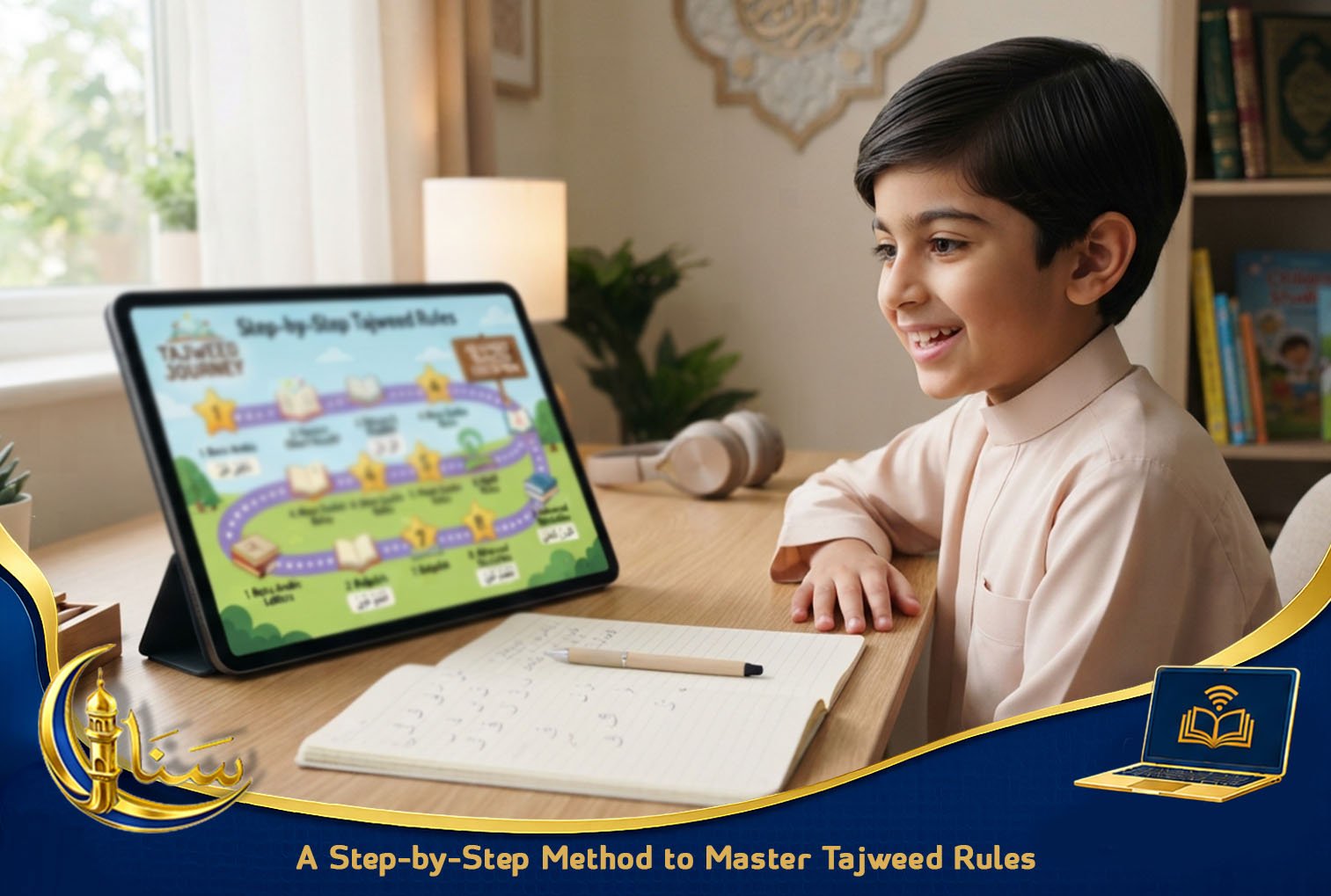
Mastering Tajweed requires a gradual approach. Trying to learn all rules at once can make beginners feel overwhelmed.
Instead, follow these steps:
- Step 1: Master Arabic Letters. First, learn each letter and its correct pronunciation.
- Step 2: Practice Harakat. Next, practice Fathah, Kasrah, and Dammah until reading becomes easier.
- Step 3: Learn Basic Tajweed Rules. After that, study simple rules such as Madd, Ghunnah, and Qalqalah.
- Step 4: Apply Rules While Reading. Then, practice these rules inside Quranic verses.
- Step 5: Improve Through Continuous Revision. Finally, continue reviewing and correcting mistakes regularly. This gradual process makes learning easier and more enjoyable.
Advanced Tips to Overcome Common Tajweed Mistakes Beginners Make and Improve Quran Recitation
After learning the basic Tajweed rules, beginners need to focus on improving accuracy, confidence, and consistency. Although understanding the rules is important, applying them naturally while reading the Quran requires continuous practice.
Therefore, learners should develop habits that support long-term improvement. Small daily efforts are often more effective than occasional intensive study because Quran recitation skills develop through repetition and regular correction.
Focus on One Tajweed Rule at a Time
One of the reasons some learners struggle is trying to memorize many Tajweed rules at the same time. However, this approach can create confusion and reduce the ability to apply rules correctly.
Instead, choose one rule and practice it until it becomes familiar.
For example:
- Spend a few days focusing on Madd.
- Then practice Ghunnah.
- After that, work on Qalqalah.
- Finally, apply these rules while reading verses.
This method creates a stronger understanding and makes Tajweed easier to remember.
Repeat Difficult Quranic Words Regularly
Many learners make the same mistakes because they move quickly from one verse to another without reviewing difficult words.
However, repetition is one of the most effective ways to improve pronunciation.
A useful method is:
- Identify difficult words.
- Write them down.
- Listen to their correct pronunciation.
- Repeat them several times.
- Read them inside the verse.
As a result, challenging words gradually become easier.
Pay Attention to Mouth and Tongue Position
Correct Tajweed depends greatly on understanding how Arabic sounds are produced. Therefore, beginners should pay attention to the movement of the tongue, lips, and mouth.
For example, some letters require:
- The tongue touching a specific area.
- A deeper sound from the throat.
- A controlled airflow.
- A specific mouth position.
Although this may feel difficult at first, regular practice makes these movements natural.
Common Tajweed Mistakes Beginners Make When Memorizing Quran Verses
Memorizing Quran is a beautiful goal; however, memorizing with incorrect pronunciation can create problems later. Therefore, beginners should focus on correct recitation before increasing memorization speed.
Some common memorization mistakes include:
- Memorizing verses without listening first.
- Repeating incorrect pronunciation.
- Focusing only on memory instead of Tajweed.
- Forgetting previous corrections.
To avoid these issues, learners should follow this approach:
First, listen to the verse carefully.
Then, read it slowly with attention.
After that, memorize it while maintaining correct pronunciation.
Furthermore, reviewing old memorized verses with Tajweed helps maintain accuracy.
The Role of Patience in Correcting Tajweed Mistakes
Learning Quran recitation requires patience because pronunciation improvement does not happen instantly. Some letters may take weeks or months of practice before becoming natural.
However, steady progress is more important than immediate perfection.
Beginners should remember that:
- Every mistake can be corrected.
- Every practice session builds improvement.
- Every corrected letter increases confidence.
Moreover, comparing your progress only with your previous level creates a healthier learning experience.
How Online Quran Lessons Help Reduce Tajweed Errors
Online Quran education has become a practical solution for many learners worldwide. It allows students to receive guidance without needing to attend a physical classroom.
Through online learning, students can:
- Attend lessons from home.
- Practice at convenient times.
- Receive individual correction.
- Review lessons easily.
- Progress according to their level.
In addition, online platforms make Quran learning available for people who may not have access to local teachers.
Sana Online Quran Academy supports learners by providing structured Quran lessons that focus on reading improvement, Tajweed understanding, and continuous practice.
The goal is not only to teach rules but also to help students apply them confidently during Quran recitation.
Creating a Successful Tajweed Learning Routine at Home
A successful learning routine does not need to be complicated. Instead, it should be realistic and consistent.
A beginner can create a simple home routine:
- Morning Practice: Read a few Quranic verses after reviewing previous mistakes.
- Listening Practice: Spend time listening to accurate Quran recitation and repeating selected verses.
- Evening Review: Review the Tajweed rule learned during the day.
Furthermore, setting a specific time for Quran practice helps create a lasting habit.
How to Choose the Right Tajweed Learning Program?
Choosing the right learning method can make the difference between slow improvement and effective progress.
A good Tajweed program should include:
- Clear explanations.
- Practical Quran reading.
- Pronunciation correction.
- Beginner-friendly lessons.
- Regular progress evaluation.
Additionally, the program should match the learner’s level. A complete beginner needs different lessons from someone who already reads Quran fluently.
Therefore, learners should choose a method that provides gradual improvement instead of overwhelming them with advanced information too early.
Why Does Correcting Tajweed Early Create Better Quran Reading Skills?

Early correction is one of the most important factors in avoiding permanent pronunciation habits. When learners repeat a mistake many times, changing it later becomes more challenging. For this reason, beginners should focus on accuracy from the beginning.
Correct learning habits include:
- Reading slowly.
- Asking for correction.
- Practicing difficult sounds.
- Reviewing regularly.
- Applying rules during actual Quran reading.
Consequently, learners build a stronger foundation and develop better confidence.
Frequently Asked Questions About Common Tajweed Mistakes Beginners Make
This section answers the most common questions beginners ask about Tajweed mistakes, pronunciation challenges, and the best ways to improve Quran recitation with confidence and accuracy.
What is the biggest Tajweed mistake beginners usually make?
The biggest mistake is often incorrect pronunciation of Arabic letters. Since every Quranic word depends on accurate letters, learning the correct articulation points should be the priority.
How long does it take to improve Tajweed?
The time required depends on the learner’s dedication, previous knowledge, and practice routine. However, regular daily practice can create noticeable improvement over time.
Can beginners learn Tajweed without knowing Arabic?
Yes, beginners can learn Tajweed without being fluent in Arabic. They can start with Arabic letters, pronunciation, and basic reading skills before moving to advanced rules.
Should children learn Tajweed at an early age?
Yes, learning Tajweed early helps children develop correct pronunciation habits. However, lessons should be suitable for their age and include encouragement and repetition.
Is online Tajweed learning effective for beginners?
Yes, online Tajweed learning can be effective when it includes structured lessons, regular practice, and pronunciation correction. A supportive learning environment helps beginners progress successfully.
In conclusion, Common Tajweed Mistakes Beginners Make can slow down Quran learning, but they can be corrected with the right approach. Tajweed is a skill that develops through knowledge, listening, practice, and patience.
Beginners should avoid rushing and focus on building strong foundations. Learning Arabic letters correctly, understanding pronunciation rules, and practicing consistently are the keys to successful Quran recitation.
Moreover, learners should remember that improvement comes gradually. Every corrected mistake brings them closer to reading the Quran with confidence and accuracy.
With organized guidance, regular practice, and a commitment to learning, anyone can improve their Tajweed skills.
Sana Online Quran Academy helps students follow a clear learning path by combining structured lessons, practical application, and continuous support. Through dedication and consistent effort, beginners can overcome pronunciation challenges and develop a stronger connection with Quran recitation.
Learning Tajweed is not only about avoiding mistakes; it is about improving the quality of Quran reading and approaching the words of Allah with care, respect, and sincerity.