
How Long Does It Take to learn Tajweed is a common question for anyone who wants to improve their Quran recitation and learn how to pronounce Allah’s words correctly. The answer depends on several factors, including the learner’s current reading level, practice routine, understanding of Arabic letters, and the quality of guidance received during the learning journey. Some students can develop strong Tajweed skills within several months, while others may need more time to build confidence and accuracy.
Learning Tajweed is not only about memorizing rules. It is a practical process that requires listening, repetition, correction, and continuous improvement. A learner needs to understand the rules and apply them naturally while reading the Quran. This process becomes easier when the student follows a structured plan and receives feedback from an experienced teacher.
At Sana Online Quran Academy, students learn Tajweed through organized lessons that focus on pronunciation, Quran reading improvement, and practical application. The academy helps learners follow a clear path based on their individual abilities, allowing beginners and advanced students to progress at a comfortable pace.
The time required to master Tajweed varies from person to person. A beginner who has never studied Arabic pronunciation may need a longer period than someone who can already read Quran fluently. However, regular practice and proper instruction can significantly reduce the learning time and help students achieve better results.
How Long Does It Take to Learn Tajweed for Beginners?
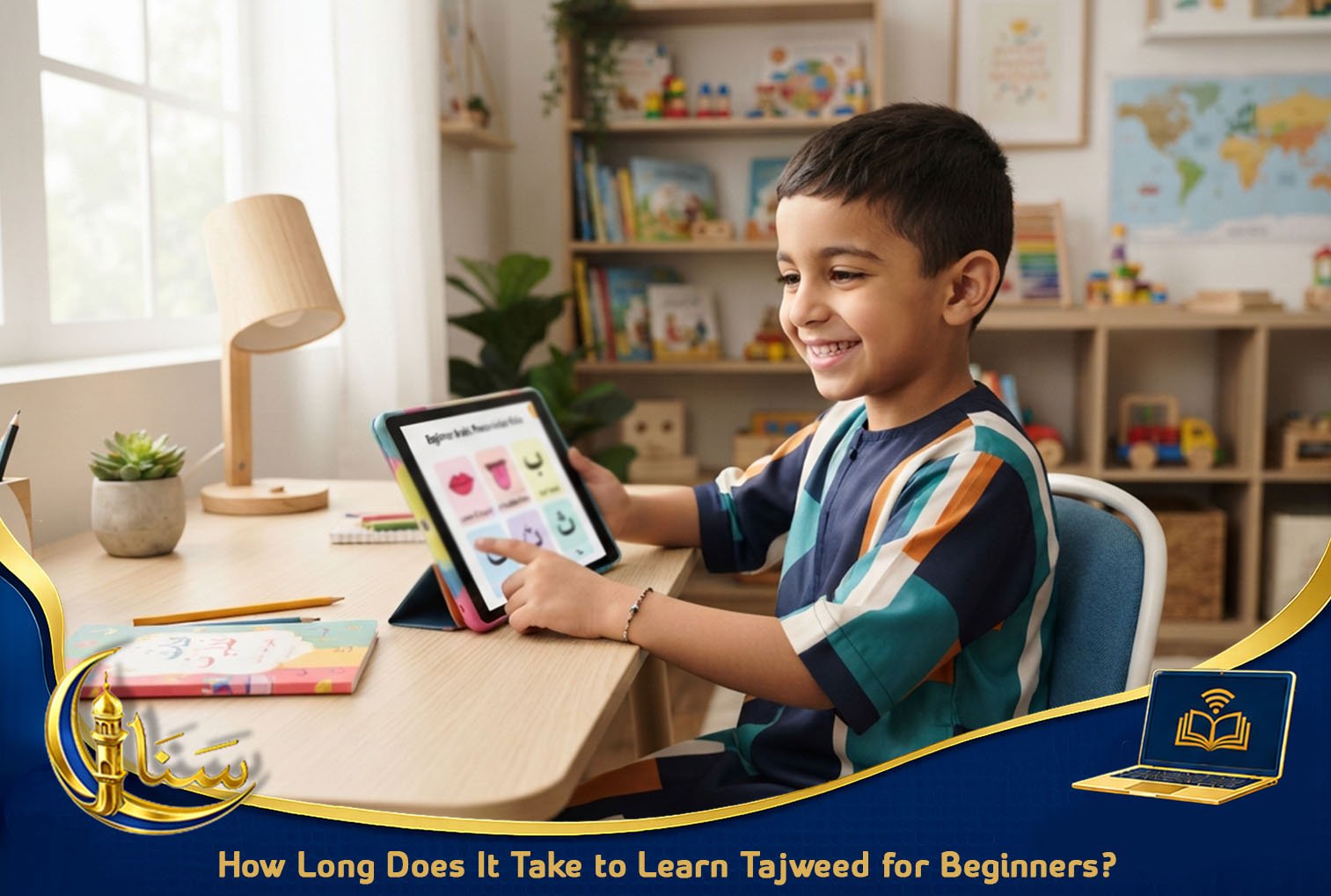
For complete beginners, How Long Does It Take to learn Tajweed depends mainly on their ability to recognize Arabic letters and their consistency in practice. Most beginners need between 6 and 12 months to develop a good understanding of the essential Tajweed rules when they study regularly.
During the first stage, students usually focus on the basics of Quran reading. They learn the correct sounds of Arabic letters, the places where letters are produced, and the differences between similar sounds. This foundation is extremely important because incorrect pronunciation habits can become difficult to change later.
A beginner’s learning journey often includes several important steps:
- Learning Arabic letters and their correct pronunciation.
- Understanding the basic rules of Tajweed.
- Practicing common Quranic words and verses.
- Applying rules during Quran recitation.
- Improving fluency and reducing mistakes.
The speed of progress depends on the amount of daily practice. A student who spends 20 to 30 minutes every day practicing Quran recitation may improve faster than someone who studies for several hours only once a week.
Consistency creates stronger results because Tajweed is a skill that requires repeated training. The tongue, mouth, and hearing ability gradually become familiar with the correct sounds through continuous practice.
Start Your Quran Learning Journey Today with Sana Online Quran Academy
Start your Quran learning journey today with Sana Online Quran Academy, where structured and simple programs are designed for both children and adults. In fact, lessons are delivered step by step by qualified teachers who focus on reading skills, basic Tajweed, and gradual improvement with clear explanations.
In addition, you can study from home with flexible schedules that fit your daily routine. Moreover, regular practice and feedback help you improve steadily. As a result, learning becomes easier, more consistent, and more effective.

What Factors Affect How Long It Takes to Learn Tajweed?
Many learners expect the same results as others, but every student has a different starting point. Several important factors influence How Long Does It Take to learn Tajweed Online and determine the speed of improvement.
Previous Quran Reading Experience
A student who already reads Arabic or Quran regularly usually progresses faster because they have experience with letters and pronunciation. They may only need to focus on improving specific Tajweed mistakes and applying advanced rules correctly.
On the other hand, a complete beginner needs additional time to build reading skills before applying Tajweed rules. Learning the foundation first makes the entire process easier and prevents confusion.
Daily Practice Routine
Practice is one of the strongest factors affecting Tajweed progress. A short daily session is often more effective than irregular long sessions. Regular repetition helps students remember rules and apply them naturally while reading.
For example, practicing every day allows learners to review:
- Makharij Al-Huruf (pronunciation points).
- Madd rules.
- Ghunnah.
- Qalqalah.
- Noon Sakinah and Tanween rules.
- Meem Sakinah rules.
A student who maintains a consistent routine usually notices improvement faster because each lesson builds on previous knowledge.
Learning Method and Teacher Guidance
Many people try to learn Tajweed independently through books or videos. These resources can be useful for understanding basic concepts, but they cannot always identify pronunciation mistakes.
Tajweed depends heavily on correct sound production. A learner may think a letter is pronounced correctly while actually making a small mistake that affects Quran recitation.
Working with a qualified teacher allows immediate correction and helps students avoid repeating incorrect habits. This type of guidance creates a more effective learning experience.
At Sana Online Quran Academy, learners receive structured Tajweed lessons designed according to their level. The focus is placed on practical reading, correction, and gradual improvement instead of only memorizing theoretical information.
How Long Does It Take to Learn Tajweed Step by Step?
Understanding the learning stages can help students create realistic expectations. Although every learner progresses differently, most students experience similar stages during their Tajweed journey.
First Stage: Learning the Foundations
The first stage usually takes one to three months. During this period, students focus on basic Quran reading skills and understanding the purpose of Tajweed.
The main goals include:
- Recognizing pronunciation mistakes.
- Learning the characteristics of Arabic letters.
- Understanding simple Tajweed concepts.
- Improving confidence while reading.
This stage creates the foundation needed for future progress. Rushing through it may cause difficulties later because advanced rules depend on accurate pronunciation.
Second Stage: Applying Tajweed Rules
After understanding the basics, students begin applying rules during actual Quran recitation. This stage may take several months because knowing a rule and using it correctly are two different skills.
A learner may memorize the definition of Ikhfa or Idgham, but applying these rules smoothly while reading requires practice and listening.
Regular correction helps students transform theoretical knowledge into practical ability.
Third Stage: Improving Fluency and Accuracy
The final stage focuses on making Tajweed natural and consistent. Students work on reducing mistakes, improving rhythm, and reading the Quran with Tajweed course confidence.
At this level, learners are no longer simply thinking about every rule. Instead, correct pronunciation becomes a natural part of their recitation.
The complete answer to How Long Does It Take to Learn Tajweed depends on reaching these stages successfully rather than completing a specific number of lessons.
How Long Does It Take to Learn Tajweed with Daily Practice?

Many students wonder How Long Does It Take to learn Tajweed if they follow a daily study schedule. The answer is that regular practice can make a significant difference because Tajweed is based on skill development rather than information alone.
A student who practices consistently can improve pronunciation, remember rules more easily, and develop better Quran reading habits. Even a short session each day can create noticeable progress when it includes focused exercises and careful correction.
An effective daily routine may include:
- Reviewing previously learned Tajweed rules.
- Listening to accurate Quran recitation.
- Practicing difficult letters and words.
- Reading selected Quran verses with attention.
- Recording mistakes and working on improvement.
The purpose of daily practice is not simply to increase study time. The goal is to build accuracy and confidence through meaningful repetition.
Some learners spend a long time studying Tajweed but progress slowly because their practice is irregular. Others improve quickly because they maintain a consistent routine and apply feedback from their teacher.
How Long Does It Take to Learn Tajweed for Non-Arabic Speakers?
For non-Arabic speakers, How Long Does It Take to learn Tajweed can be different because they may need extra time to become familiar with Arabic sounds. Certain letters, such as ع, ح, خ, ص, and ض, may be challenging because they do not exist in many languages.
However, learning Tajweed is completely achievable for non-Arabic speakers. Many students successfully learn correct Quran pronunciation by following a structured learning plan.
The main challenges for non-Arabic speakers usually include:
- Understanding Arabic pronunciation points.
- Distinguishing between similar letters.
- Developing correct tongue and mouth movement.
- Applying rules while reading continuously.
With patience and proper guidance, these challenges become easier. The learner gradually trains their hearing and pronunciation until correct sounds become more natural.
At Sana Online Quran Academy, lessons are designed to support students from different language backgrounds. The teaching approach focuses on clear explanations, repeated practice, and individual correction to help learners overcome pronunciation difficulties.
What Are the Main Tajweed Rules That Require More Practice?
Not every Tajweed rule requires the same amount of time. Some rules are easier to understand, while others need more practical training before students can apply them correctly.
Makharij Al-Huruf (Letters’ Articulation Points)
Learning the correct pronunciation points of Arabic letters is one of the most important parts of Tajweed. Every Arabic letter has a specific place from which its sound comes.
Students often need extra practice to differentiate between letters that sound similar. For example, they must learn the difference between:
- س and ص.
- ت and ط.
- د and ض.
- ه and ح.
Understanding these differences protects the meaning of Quranic words and improves the beauty of recitation.
Madd Rules
Madd refers to elongating certain sounds according to Tajweed rules. Although many students understand the basic idea quickly, applying the correct length while reading requires practice.
A learner must develop the ability to recognize different types of Madd and apply them naturally without interrupting the flow of recitation.
Ghunnah Rules
Ghunnah is another important area that requires attention. It involves a nasal sound that appears in specific situations, especially with Noon and Meem rules.
Students often understand when Ghunnah occurs but need repeated practice to produce the correct sound and duration.
Can You Learn Tajweed Without a Teacher?
Some learners ask How Long Does It Take to learn Tajweed when studying alone. Self-learning can provide basic knowledge about Tajweed rules, but reaching accurate Quran recitation is usually more difficult without personal feedback.
Books and online videos can explain concepts, but they cannot listen to the student and identify specific mistakes. A learner may repeat the same pronunciation error many times without realizing it.
A teacher provides several important benefits:
- Correcting mistakes immediately.
- Explaining difficult rules clearly.
- Helping students improve pronunciation.
- Creating a suitable learning plan.
- Encouraging consistent practice.
Traditional Quran learning has always depended on listening and correction between teacher and student. This method helps preserve accurate pronunciation and proper recitation.
Online learning has also made access to qualified teachers easier. Students can now receive live guidance from their homes while following a structured program.
How Long Does It Take to Learn Tajweed and Read Quran Fluently?
Learning Tajweed and achieving fluent Quran recitation are connected goals, but they require patience. A student may understand many rules but still need additional practice before reading smoothly.
Fluency develops through:
Continuous Reading Practice
Reading Quran regularly helps students become more comfortable with words, verses, and different Tajweed situations.
Listening to Skilled Reciters
Listening improves the learner’s ability to recognize correct pronunciation, rhythm, and application of rules.
Regular Correction
Receiving feedback helps students notice mistakes and replace incorrect habits with correct ones.
The journey from beginner level to confident recitation is gradual. Some students reach a comfortable level within several months, while others continue improving for years.
The Role of a Structured Tajweed Program in Faster Progress

A structured learning program can make the Tajweed journey clearer and more organized. Instead of randomly studying different rules, students follow a planned sequence that builds knowledge step by step.
A good program usually begins with:
- Quran reading assessment.
- Identifying pronunciation weaknesses.
- Teaching essential rules.
- Practicing verses with guidance.
- Reviewing progress regularly.
This approach prevents students from feeling overwhelmed and helps them focus on the areas that need improvement.
Sana Online Quran Academy provides organized Quran and Tajweed lessons that help students develop their skills through gradual learning. The academy focuses on helping each learner understand rules and apply them correctly during Quran recitation.
How Long Does It Take to Learn Tajweed at an Advanced Level?
Students who want to achieve advanced Tajweed skills need more time because advanced learning involves detailed correction and deep understanding of recitation styles.
Advanced Tajweed includes:
- Perfecting pronunciation of all Arabic letters.
- Applying rules consistently throughout the Quran.
- Improving voice control and recitation quality.
- Understanding advanced Tajweed principles.
For many learners, reaching an advanced level may take one to several years depending on their dedication and learning goals.
Students who aim for complete mastery should focus on quality rather than speed. Tajweed is a lifelong skill that continues to improve with practice and revision.
How Long Does It Take to Learn Tajweed for Children and Adults?
Many parents and adults ask How Long Does It Take to learn Tajweed because they want to choose the right learning path and understand the expected progress. The answer depends on age, previous experience, learning ability, and commitment to regular practice.
Children often learn pronunciation naturally because they are still developing their language skills. They can build strong foundations when they start with simple lessons that match their age and learning style. However, children still need patience, encouragement, and regular revision to maintain progress.
Adults may need more conscious practice because they might have developed pronunciation habits from another language. Despite this, adults can achieve excellent Tajweed skills when they follow a clear plan and dedicate consistent time to learning.
The most important factor is not age but commitment. A motivated learner who practices regularly can make steady progress regardless of their starting level.
How Long Does It Take to Learn Tajweed Through Online Classes?
Online learning has become a practical option for students who want flexible Quran education. Many learners choose online Tajweed classes because they can study from home while receiving direct guidance from qualified teachers.
The effectiveness of online learning depends on the quality of the program, interaction with the teacher, and the student’s commitment.
A successful Best Online Tajweed Classes experience usually includes:
- Live lessons with direct communication.
- Individual pronunciation correction.
- A clear learning schedule.
- Regular assignments and revision.
- Progress evaluation.
Online classes can provide the same benefits as traditional learning when they include personal guidance and active practice.
At Sana Online Quran Academy, students can follow a flexible Tajweed learning program designed to meet different needs. Lessons focus on improving Quran reading, correcting mistakes, and helping students gain confidence step by step.
Common Mistakes That Slow Down Tajweed Learning
Understanding Common Tajweed Mistakes Beginners Make can help learners avoid delays and achieve better results. Many students struggle not because Tajweed is impossible, but because they follow ineffective learning habits.
Studying Rules Without Practical Application
Some learners spend a lot of time memorizing Tajweed definitions but do not practice applying them during Quran reading. Tajweed is a practical science, so rules must be connected to actual recitation.
Practicing Inconsistently
Long gaps between lessons can slow progress because pronunciation skills require regular repetition. Missing practice for extended periods may cause students to forget previous improvements.
Ignoring Pronunciation Correction
A learner who does not receive correction may continue repeating mistakes. Small pronunciation errors can become difficult habits if they are not addressed early.
Trying to Learn Too Many Rules at Once
Tajweed includes many concepts, but learning everything quickly can create confusion. A gradual approach allows students to understand each rule and apply it correctly before moving forward.
How to Make Your Tajweed Learning Journey Faster and More Effective?
Although every learner has a different timeline, several strategies can help improve progress and make learning more productive.
Set a Realistic Practice Schedule
A realistic schedule is easier to maintain than an intense plan that cannot continue. Even 20 minutes of focused practice each day can create strong improvement over time.
Focus on Quality Before Speed
The goal of Tajweed is accurate Quran recitation, not simply finishing lessons quickly. Taking enough time to master each skill creates stronger results.
Listen and Repeat
Listening to skilled Quran reciters helps train the ear and improves awareness of correct pronunciation. Repeating after a reciter can help students practice rhythm and articulation.
Review Previous Lessons Regularly
Revision prevents forgetting and strengthens previously learned skills. Regular review also helps students notice their improvement and identify areas that need more attention.
How Long Does It Take to Learn Tajweed and Master Quran Recitation Completely?
The journey toward complete Tajweed mastery does not have a fixed ending point. Even advanced students continue improving their recitation through regular practice and revision.
A general learning timeline may look like this:
- 1 to 3 months: Understanding basic rules and improving pronunciation awareness.
- 3 to 6 months: Applying common Tajweed rules during Quran reading.
- 6 to 12 months: Developing stronger accuracy and confidence.
- 1 year and beyond: Refining skills and improving recitation quality.
These periods are estimates because each student has unique circumstances. The quality of practice is more important than the number of months spent learning.
Students who continue their journey with dedication often discover that Tajweed becomes more than a set of rules. It becomes a way to connect more deeply with the Quran and appreciate the beauty of its recitation.
Why Choosing the Right Learning Environment Matters

The learning environment can influence motivation and progress. A supportive environment encourages students to practice, ask questions, and improve without feeling discouraged.
A suitable Tajweed program should provide:
- Experienced instructors.
- A clear curriculum.
- Personalized feedback.
- Flexible lesson options.
- Continuous encouragement.
Sana Online Quran Academy aims to create a supportive learning environment where students can improve their Quran recitation at their own pace. The academy helps learners build confidence while focusing on accurate application of Tajweed, which is important in Quran reading.
Frequently Asked Questions About Learning Tajweed
Discover clear answers to common questions about learning Tajweed, including how long it takes, which skills beginners should start with, and how regular practice can improve Quranic recitation.
Is Tajweed necessary for every Quran reader?
Tajweed helps Muslims recite the Quran correctly by protecting pronunciation and maintaining the proper sounds of Arabic letters. Learning its basic rules improves reading accuracy and helps avoid common mistakes.
Can someone learn Tajweed at an older age?
Yes, Tajweed can be learned at any age. Adults may need more practice with pronunciation, but consistent effort and proper instruction can lead to excellent results.
How many hours should I practice Tajweed every day?
The ideal practice time depends on the learner’s schedule, but regular daily practice of 20 to 30 minutes can produce noticeable improvement when done consistently.
What should I learn before starting Tajweed?
A basic understanding of Arabic letters and Quran reading is helpful before studying advanced Tajweed rules. Beginners can start with pronunciation foundations before moving to detailed rules.
Does learning Tajweed improve Quran memorization?
Yes, correct pronunciation and better understanding of recitation patterns can support Quran memorization by making verses easier to remember and recall.
In conclusion, the answer to How Long Does It Take to Learn Tajweed depends on many factors, including your current Quran reading ability, practice routine, learning method, and personal goals. Some students may reach a good level within six months, while others may need more time to develop complete confidence.
Tajweed is not a skill that should be rushed. The purpose is to learn how to recite the Quran correctly, beautifully, and respectfully. Consistent practice, proper guidance, and patience are the keys to long-term success.
Every learner has a different journey, but progress is possible with dedication and the right support. Whether you are a beginner who is learning Arabic letters or someone who wants to improve existing Quran recitation skills, following a structured Tajweed plan can help you achieve your goal.
With professional guidance from Sana Online Quran Academy, students can develop their recitation abilities through organized lessons, practical exercises, and continuous improvement.