
The best Quran Memorization Techniques can make the journey of memorizing the Quran more organized, manageable, and rewarding. Although every learner has a different memory style, successful Hifz usually depends on a combination of repetition, regular revision, correct recitation, understanding, and consistent practice. Therefore, the goal is not simply to memorize many verses quickly. Instead, the real objective is to build strong and lasting memorization that remains accurate over time.
Memorizing the Quran is a spiritual journey as well as a learning process. Some students remember what they hear, while others depend more on seeing the Mushaf, writing verses, or connecting passages through meaning. Consequently, a technique that works extremely well for one learner may feel uncomfortable for another.
The good news is that you do not need to use every method at once. You can experiment with several approaches, identify the ones that suit your memory, and then create a realistic routine. In addition, a qualified teacher can help you recognize mistakes that may otherwise become difficult to correct later.
This guide explains practical memorization strategies for beginners, children, teenagers, and adults. It also shows how repetition, listening, writing, understanding, revision, and teacher supervision can work together to create a sustainable Hifz routine.
Best Quran Memorization Techniques for Beginners

Beginners often make one common mistake: they focus only on how much they can memorize in a single sitting. However, memorization is not a race. A small amount learned correctly and reviewed consistently is usually more useful than a large amount that disappears after a few days.
Start with a manageable portion. For example, you might memorize one or two verses during your first sessions. Once your concentration improves, you can gradually increase the amount. At the same time, keep previously memorized verses in your daily schedule.
Before beginning, choose one Mushaf and continue using it whenever possible. The consistent visual layout can help your mind remember where particular verses appear on the page. Furthermore, choose a quiet study location and remove unnecessary distractions.
Another important step is to listen to a reliable recitation before memorizing. Hearing the verses repeatedly allows you to become familiar with their pronunciation, rhythm, pauses, and overall sound. Afterward, read the passage yourself while looking carefully at the Mushaf.
Most importantly, make accuracy your priority. If you memorize an incorrect pronunciation repeatedly, correcting it later can be much harder.
Start Your Quran Learning Journey Today with Sana Online Quran Academy
Start your Quran learning journey today with Sana Online Quran Academy, where structured and simple programs are designed for both children and adults. In fact, lessons are delivered step by step by qualified teachers who focus on reading skills, basic Tajweed, and gradual improvement with clear explanations.
In addition, you can study from home with flexible schedules that fit your daily routine. Moreover, regular practice and feedback help you improve steadily. As a result, learning becomes easier, more consistent, and more effective.

Best Quran Memorization Techniques Based on Repetition
Repetition is one of the foundations of Hifz. Nevertheless, repeating words mechanically is not enough. Effective repetition requires attention, accurate pronunciation, and active recall.
A useful approach is to read one verse several times while looking at the Mushaf. Then close the Mushaf and recite the verse from memory. If you make a mistake, return to the text, identify the exact point of difficulty, and repeat the process.
Next, connect the verse to the following verse. Rather than memorizing isolated sentences, practice the transition between them. This matters because many students can remember individual verses but struggle when moving from one verse to another.
You can also use a structured repetition pattern. For instance, read a verse seven times, recite it several times without looking, and then combine it with the next verse. If that number feels excessive or insufficient, adjust it according to your ability.
The important principle is consistency. Repetition should help move information from short-term familiarity toward reliable long-term recall.
7×3 Method for Quran Memorization
The 7×3 method provides a simple structure for students who need clear repetition targets. First, read the selected verse seven times while looking carefully at the Mushaf. During these repetitions, pay attention to every word, vowel, pronunciation rule, and stopping point.
Afterward, attempt to recite the verse three times without looking. If you make a mistake, do not immediately move forward. Instead, look at the difficult section again and repeat it until the problem becomes clear.
Once two verses have been memorized, combine them. Recite both together several times so your mind learns the connection between them. Then add another verse and repeat the process.
This method is particularly useful for beginners because it divides a large task into smaller stages. Furthermore, the combination stage prevents the memorizer from learning each verse as an isolated unit.
10×10 Method for Stronger Recall
The 10×10 method increases the amount of repetition and may be helpful when a passage feels difficult.Begin by reading the selected verse ten times. Then attempt to recite it without looking. After learning the next verse, connect the two and repeat the combined section.
The value of this technique comes from consolidation. Instead of stopping immediately after you can remember a verse once, you continue practicing until the sequence becomes more stable.
However, more repetition does not automatically mean better memorization. If your concentration becomes weak, take a short break. Otherwise, you may continue reciting while your attention gradually disappears.
For difficult passages, you can divide the verse into smaller phrases. Memorize each phrase carefully and then reconnect the phrases. As a result, long or unfamiliar verses become less intimidating.
20×20 Memorization Approach
Some learners benefit from a more intensive repetition schedule. The 20×20 approach involves repeating a selected line or passage many times before moving to new material.
Although this method can require considerable time, it can be useful when the learner repeatedly forgets the same passage. The first set of repetitions creates familiarity, while the second set strengthens recall.
Nevertheless, you should not assume that everyone needs twenty repetitions every time. A student who remembers quickly may require fewer repetitions, whereas another learner may need considerably more.
Therefore, use repetition as a flexible tool rather than an inflexible rule. Your objective is strong recall, not reaching a specific number simply for the sake of reaching it.
Best Quran Memorization Techniques Using Half Pages
A half-page method is a practical choice for students who find full-page memorization overwhelming.
Start by dividing the page into two manageable sections. Read the first section carefully and listen to a trusted reciter if necessary. Then repeat the passage while paying attention to pronunciation and verse connections.
After several repetitions, cover the text and recite the section from memory. Correct every error before proceeding. Once the first half is secure, move to the second half. Later, connect both sections and recite the entire page.
This technique works well because it reduces cognitive load. Instead of asking yourself to remember an entire page immediately, you create two smaller goals and then combine them.
Whole-Page Memorization Method
Some experienced students prefer to memorize an entire page as one visual unit. This approach can be especially useful for learners who naturally remember the position and appearance of words on the page.
Begin by reading the complete page slowly. Do not rush simply because you are familiar with the vocabulary. Instead, focus on the exact order of the verses and the location of important phrases.
After repeated readings, divide the page mentally into smaller sections. Practice each section individually, and then recite the page from beginning to end.
Visual memory can be helpful here. You may remember that a particular phrase appeared near the top, middle, or bottom of a page. Consequently, using the same Mushaf consistently can support this type of recall.
However, visual memory should complement recitation rather than replace it. The final test is whether you can recite accurately without looking.
Bottom-to-Top Memorization Technique
The bottom-to-top approach reverses the usual direction of memorization. Instead of beginning with the first line, the student starts from the last line and gradually works upward.
For some learners, this unusual sequence makes individual lines easier to distinguish. It can also reduce confusion when several verses have similar endings or repeated structures.
After memorizing from the bottom upward, review the passage in the normal direction from top to bottom. This second stage is essential because Quranic recitation normally requires you to move through the verses in their established sequence.
This approach is not necessary for everyone. Rather, it can be tested when conventional memorization feels repetitive or confusing.
Best Quran Memorization Techniques Through Listening
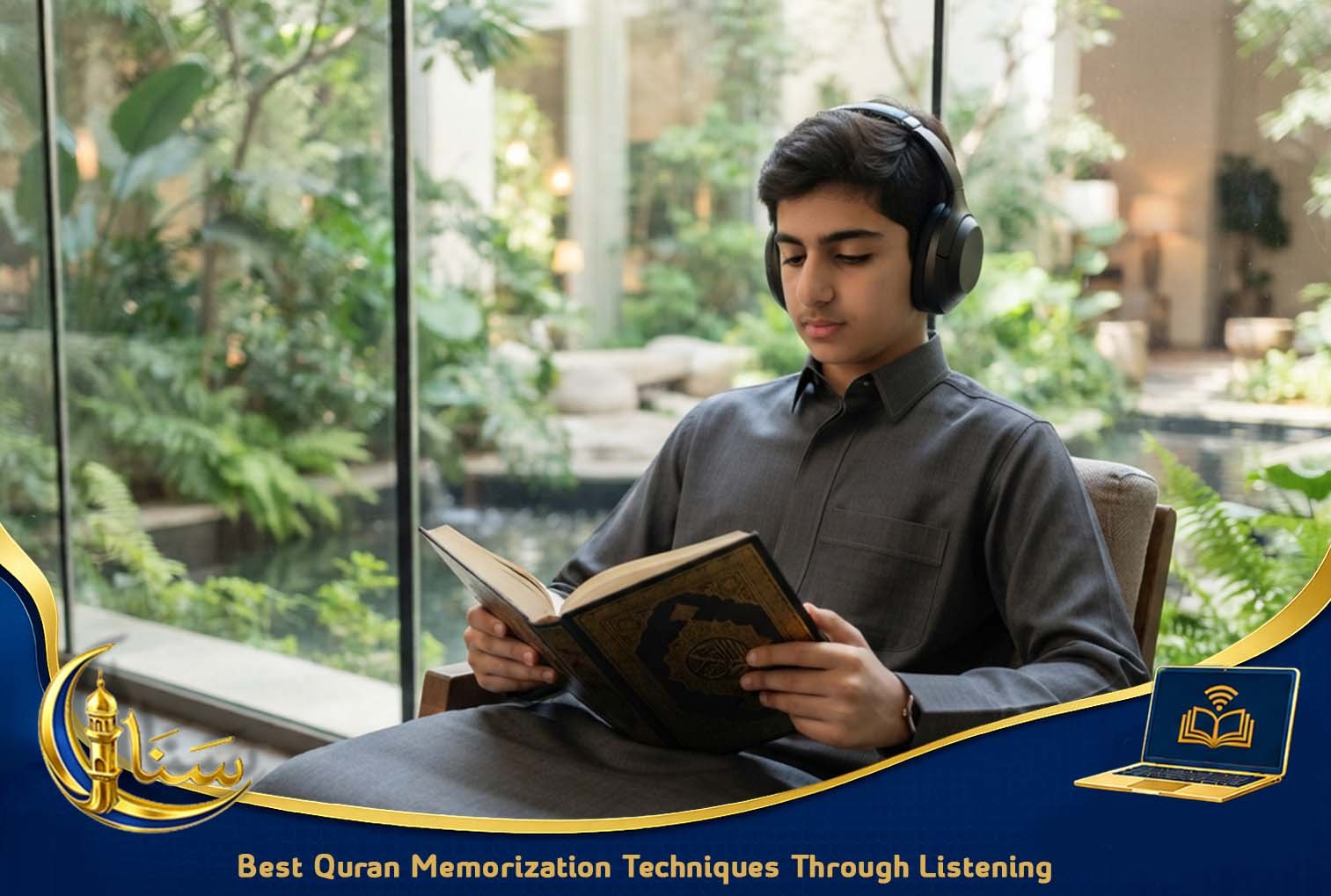
Auditory learning can play a major role in Quran memorization. Many students find that repeated listening helps them recognize verses even before they can recite them independently.
Choose a qualified reciter whose pronunciation is clear and whose recitation you can follow comfortably. Listen to a short passage several times. Then read along with the recording while watching the Mushaf.
Afterward, pause the recording and attempt the same passage yourself. You can then replay the verse to compare your pronunciation and rhythm.
Listening can also be useful during light daily activities. For example, you might listen while traveling, walking, or preparing for the day. However, active memorization should still include focused sessions because passive listening alone does not guarantee accurate recall.
Furthermore, avoid constantly changing reciters while learning a new passage. Consistency makes it easier to recognize the same pronunciation patterns and pauses.
Visual Memorization and the Mushaf
Visual memory can support Hifz by helping the learner remember the physical location of verses. Use the same Mushaf whenever possible. Over time, your mind may begin to associate certain passages with specific areas on the page.
You might remember that a particular verse appeared near the bottom of the left page or that a similar phrase appeared several lines earlier. Nevertheless, do not depend entirely on page images. The ability to recite without seeing the page remains essential.
To strengthen visual recall, read the passage carefully, close the Mushaf, and visualize its layout. Then recite from memory. If you become uncertain, open the Mushaf and check the exact wording.
Writing Verses to Strengthen Memorization
Writing can provide another path into memory. When you write a verse by hand, you engage visual attention and physical movement at the same time.
Begin by copying a short passage accurately. Check your writing against the Mushaf afterward. Once you become comfortable, try writing the passage without looking.
This exercise is especially useful for identifying words that you frequently confuse. If you repeatedly forget a particular word, writing it several times can make its shape and position more familiar.
You do not need to write every verse every day. Instead, use writing strategically when a passage remains difficult despite repeated reading and recitation.
Linking Verses Through Associations
Another strategy is to create mental links between consecutive verses. The purpose is not to replace understanding or recitation, but to create additional memory cues.
For example, you might identify the main idea of one verse and connect it mentally with the idea of the following verse. You can also notice changes in subject, repeated expressions, questions, commands, descriptions, or shifts in narrative.
These connections help answer an important question: “What comes next?”
When a learner understands the relationship between passages, moving from one verse to another can become more natural. Therefore, linking should focus primarily on meaningful relationships within the Quran rather than random associations.
Best Quran Memorization Techniques Through Understanding
Understanding the meaning of the verses can make memorization more meaningful and, in many cases, easier.
Before memorizing a passage, read a reliable translation and learn its general theme. You do not need to become an expert in Quranic Arabic before beginning Hifz. Even a basic understanding can help you recognize the logical flow of the passage.
For example, if several verses describe a sequence of events, knowing that sequence can help you remember their order. Similarly, recognizing repeated concepts can prevent you from confusing similar passages.
Understanding also changes the experience of memorization. Instead of repeating unfamiliar words, you begin to recognize a message and connect each verse with its broader context.
However, translation should not replace the Arabic text. The Quran is memorized in its original Arabic wording, while translation serves as a tool for comprehension and reinforcement.
Continuous Revision: The Key to Long-Term Hifz
New memorization often receives too much attention, while revision receives too little. Yet forgetting is a natural part of memory. Without regular review, previously memorized portions can gradually become weaker. For that reason, divide your study session between new lessons and older material.
A beginner might spend part of the session revising yesterday’s lesson before learning something new. As the memorized portion grows, the review system should also grow.
You can create three categories:
- Recent revision: material learned during the last few days.
- Medium-term revision: portions memorized during previous weeks.
- Long-term revision: older Juz and Surahs that require regular maintenance.
This structure keeps old material active while allowing you to continue progressing. Moreover, review should include reciting without looking. Reading the Mushaf repeatedly can create a false feeling of confidence because the text is always available. Active recall provides a much more accurate test.
Best Quran Memorization Techniques for Daily Revision
A daily revision routine does not need to be extremely long. What matters most is that it is realistic enough to maintain.
For instance, you can begin your morning by revising recent verses. Later, dedicate another short period to older memorized portions. In the evening, test yourself on the day’s new lesson.
You can also divide longer revision sessions into smaller blocks. A short, focused session may be more productive than an exhausting session in which concentration disappears.
Furthermore, use Salah as an opportunity to reinforce memorized Surahs where appropriate. Reciting what you have learned in prayer can provide additional repetition and help connect memorization with worship.
Still, avoid turning every prayer into a stressful examination. The goal is to strengthen your relationship with the Quran while maintaining accurate recitation.
Memorization Under Qualified Supervision
Learning independently is possible, but teacher supervision can make the process much more reliable. A qualified Quran teacher can listen to your recitation and identify errors that you may not notice yourself. This is particularly important with pronunciation, articulation points, elongations, stopping rules, and other Tajweed matters.
Additionally, a teacher can help determine how much new material you should memorize. If your revision is becoming weak, the teacher may recommend reducing new material temporarily.
Sana Online Quran Academy can provide structured Online Hifz Classes and Quran learning with teacher guidance for students who prefer studying from home. A supervised learning environment can also help learners remain accountable and maintain a regular schedule.
When selecting a teacher, look beyond speed. A good teacher should prioritize correct recitation, patient correction, appropriate pacing, and consistent revision.
Best Quran Memorization Techniques for Children
Children often need a different approach from adults. Their attention span may be shorter, so long sessions can become frustrating.
Begin with small portions and use repetition in a positive environment. Listening can be particularly effective because children often imitate sounds naturally.
Parents can also create a predictable routine. A child may memorize more successfully when the same study time is used each day.
Praise effort rather than focusing exclusively on the number of verses memorized. For example, acknowledge careful pronunciation, successful revision, and perseverance.
Visual aids can also help. A child may enjoy following the words with a finger, using a familiar Mushaf, or writing selected words.
Most importantly, avoid making memorization feel like punishment. A supportive environment encourages children to develop a lasting love for the Quran.
Sana Online Quran Academy can also be considered by families seeking structured online lessons for children. Online Quran Memorization for Children may offer greater flexibility when family schedules make traditional classes difficult.
Best Quran Memorization Techniques for Adults

Adults frequently face different challenges. Work, family responsibilities, and unpredictable schedules can make daily Hifz difficult.
Therefore, adults should build a routine around their actual lives rather than an ideal schedule they cannot maintain. Choose a realistic daily target. Even a small amount can become significant when practiced consistently for months.
Morning sessions may work well for people who have greater concentration early in the day. Others may prefer an evening routine. The best time is the one you can maintain consistently.
Adults should also resist comparing their progress with younger students. Age does not determine commitment or the value of the journey.
If a busy day prevents new memorization, use that day for revision instead. Maintaining previous material is still meaningful progress.
Creating a Personalized Hifz Schedule
A successful memorization schedule should answer four questions:
- What will I memorize?
- When will I memorize it?
- When will I revise it?
- How to Memorize Quran Faster will I test myself?
Start by deciding on a daily or weekly target. Then reserve specific time for revision before increasing the amount of new material.
For example, a simple routine might include a short warm-up, revision of previous lessons, new memorization, and a final recitation test.
You can adjust the schedule as your workload changes. During busy periods, reduce the new lesson while protecting revision time. During holidays, you may increase your target if your concentration and available time allow it.
Sana Online Quran Academy may be useful for learners who need external structure and regular teacher feedback while following a personalized memorization plan.
The Importance of Tajweed During Memorization
Memorization should not be separated from correct recitation. If a learner memorizes a verse incorrectly, repeated practice can reinforce the mistake.
Therefore, learn the basic Tajweed rules relevant to your current level. Pay attention to articulation points, elongations, nasal sounds, stopping and starting, and other rules that affect pronunciation.
When you begin a new passage, read it slowly. Listen to an accurate recitation, then imitate it under teacher supervision when possible.
Do not sacrifice accuracy for speed. Finishing a page quickly is not an achievement if significant pronunciation errors remain.
Instead, allow yourself enough time to produce each word correctly. As your recitation improves, your memorization will also become more dependable.
How to Handle Similar Quranic Verses?
Similar verses can be among the most challenging parts of Hifz. You may remember the general meaning but accidentally replace one phrase with another from a different Surah.
When this happens, compare the passages carefully. Identify the exact words that differ and write them down if necessary.
Then practice the transition surrounding the difficult phrase. Do not memorize only the isolated word. Instead, recite the sentence before it, the difficult phrase, and the sentence after it.
Understanding context can also help. Ask yourself why the wording changes and what subject the verse addresses.
Over time, these distinctions become clearer. However, similar passages should receive additional revision rather than being treated as ordinary mistakes.
Common Mistakes That Weaken Quran Memorization
One common mistake is memorizing too much new material without sufficient revision. The student may feel productive initially, but older portions become weak.
Another problem is the frequent changing of the Mushaf. Different page layouts can make visual recall less stable. Some learners also rely heavily on listening without testing themselves. Listening is useful, but active recitation is essential.
Others memorize while distracted. Watching videos, checking messages, or frequently stopping the session reduces concentration.
In addition, skipping teacher correction can allow pronunciation mistakes to become habitual. Finally, many students become discouraged because they expect perfect recall immediately. Forgetting does not mean that you are incapable of memorizing. It means that your revision system needs attention.
How to Stay Motivated During Hifz?
Motivation naturally rises and falls. Therefore, do not depend entirely on motivation to maintain your routine.
Instead, create habits that make studying easier. Keep your Mushaf ready, choose a consistent time, and establish a realistic daily target.
Remember why you started. For many learners, the purpose is not simply completing a memorization goal. It is to preserve the Quran in the heart, improve recitation, strengthen worship, and develop a closer relationship with Allah.
Celebrate small milestones. Completing a Surah, strengthening a difficult Juz, or successfully maintaining older memorization are all meaningful achievements.
When progress feels slow, look back at what you have already learned. This perspective can restore confidence.
Using Technology Without Becoming Distracted
Technology can support a Quran memorization course when used intentionally. Audio recordings can provide repeated exposure to a selected passage. Digital Mushaf applications can make the Quran accessible while traveling. Recording your own recitation can also help you identify mistakes.
However, technology can become a distraction if you constantly switch between applications. Keep your memorization tools simple.
Choose one trusted source for the Mushaf, one or more reliable recitations, and a practical method for tracking progress.
Online lessons can add another level of accountability. For example, Sana Online Quran Academy can support learners who prefer scheduled Quran instruction without traveling to a physical classroom.
The important point is to use technology as a learning aid rather than allowing it to interrupt concentration.
How to Measure Memorization Progress
?
Progress should not be measured only by the number of pages completed. A stronger evaluation considers several factors:
- Can you recite the passage without looking?
- Can you maintain the correct order?
- Are pronunciation and Tajweed accurate?
- Can you connect one verse smoothly to the next?
- Can you still remember the passage after several days?
- Can you recite older material confidently?
If the answer to several of these questions is no, slow down and strengthen the existing material. A slower pace with strong retention is generally more sustainable than rapid memorization followed by extensive forgetting.
Combining Several Memorization Methods
You do not have to choose only one method for your entire Hifz journey. For example, you might listen to a passage before studying it, use repetition for the first stage, divide a page into smaller sections, and then use writing for difficult words. Later, you can focus on continuous revision and active recall.
Combining methods is especially useful when your memory responds to multiple types of input. However, avoid creating a complicated routine that takes more time to organize than to study. Start with two or three techniques. Once you know what works, keep the process simple.
A Practical Weekly Hifz Routine
A balanced weekly plan can include both new lessons and revision.
- Day 1: Learn a small new passage and revise the previous lesson.
- Day 2: Review Day 1 before learning the next passage.
- Day 3: Continue new memorization while revising the previous two lessons.
- Day 4: Focus on connecting the passages and correcting weak points.
- Day 5: Learn new material only if previous lessons remain strong.
- Day 6: Dedicate additional time to older memorization.
- Day 7: Reduce new material and conduct a broader review of the week’s work.
This schedule can be adjusted according to age, available time, and memorization level. The central principle remains the same: new memorization should never completely replace revision.
Best Quran Memorization Techniques and Spiritual Consistency
Hifz is more than a memory exercise. The Quran is a source of guidance, so memorization should be accompanied by respect, reflection, and sincere intention.
Begin your study with a clear intention. Ask Allah for ease, understanding, and steadfastness.
Try to maintain good manners with the Quran and approach your lessons with patience. When memorization becomes difficult, remember that every effort has value.
Furthermore, do not measure your spiritual journey by comparison with another person. One learner may memorize quickly but need extensive revision, while another may progress slowly and retain each passage strongly.
The most important goal is consistency and sincerity.
How Sana Online Quran Academy Can Support Hifz?
For students who prefer online learning, Sana Online Quran Academy for Hifz can provide a structured environment for Quran memorization. Regular lessons can help learners establish accountability instead of relying entirely on self-study.
Teacher feedback is especially useful when the student needs help with pronunciation, memorization pace, revision, or difficult passages.
A structured course can also make it easier to divide the Quran into achievable stages. Rather than approaching the entire Mushaf as one enormous task, the learner can work toward smaller goals.
Sana Online Quran Academy may also be suitable for students whose schedules make in-person classes difficult. Online learning allows lessons to fit more easily around school, work, or family responsibilities.
Nevertheless, the effectiveness of any program depends on the student’s consistency. A teacher can guide the journey, but regular practice remains essential.
Best Quran Memorization Techniques: A Simple Strategy to Start Today

The Best Quran Memorization Techniques begin with a simple and consistent routine. Choose a short passage that matches your level, read it carefully from the Mushaf, and listen to a reliable recitation.
Then repeat the passage several times while focusing on correct pronunciation and Tajweed. Afterward, close the Mushaf and recite the verses from memory. If you make a mistake, return to the difficult phrase, correct it, and repeat it until you can recall it confidently.
Next, connect the passage with the following verse to strengthen the sequence. Before ending your session, review some previously memorized verses. The following day, revise yesterday’s lesson before learning anything new. After a few weeks, evaluate your progress.
If your previous memorization remains strong, gradually increase your target. However, if you notice frequent forgetting, reduce new material and focus more on revision. This balanced approach helps you build strong, lasting memorization without unnecessary pressure.
Frequently Asked Questions About Best Quran Memorization Techniques
Find answers to common questions about the Best Quran Memorization Techniques, including effective memorization methods, revision routines, and ways to strengthen Hifz.
1. How long does it take to memorize the Quran?
There is no universal timeline. The duration depends on the learner’s available time, age, memorization ability, previous Quranic knowledge, revision routine, and consistency. A steady pace is usually more sustainable than rushing toward a deadline.
2. Should I memorize Quran in the morning or at night?
The best time is the period when you can concentrate consistently. Many learners prefer early morning because the environment may be quieter, while others perform better in the evening. Test both options and choose the one that produces stronger recall.
3. What should I do if I keep forgetting the same Surah?
Identify the exact point where you forget. Then compare the surrounding verses, listen to the passage, and increase targeted revision. You may also need to reduce new memorization temporarily until the weak section becomes stable.
4. Is it possible to memorize the Quran without knowing Arabic?
Yes. A learner can memorize the Arabic text without being fluent in Arabic. However, learning the meanings and basic Quranic vocabulary can make the process more meaningful and may help with retention.
5. Should I memorize quickly or focus on perfect retention?
Accuracy and long-term retention should take priority. A slower pace is perfectly acceptable if it produces stronger memorization and better recitation. The goal is not merely to finish quickly but to preserve what you have learned.
In conclusion, the journey of Quran memorization requires patience, discipline, and a realistic routine. There is no single strategy that works identically for every learner. Instead, successful students often combine repetition, listening, visual memory, writing, understanding, active recall, and continuous revision.
The most effective approach is the one that you can follow consistently while maintaining accurate recitation. Begin with a manageable target, review previous material frequently, and increase your workload only when your foundation is strong.
Teacher supervision can also make a significant difference, especially when pronunciation and Tajweed need correction. For learners seeking structured online guidance, Sana Online Quran Academy can be part of a consistent Hifz routine.
Ultimately, memorizing the Quran is a long-term commitment rather than a short competition. Progress may sometimes feel slow, yet every correctly memorized verse represents meaningful progress. With sincere intention, regular revision, careful recitation, and the right strategy, learners can build memorization that remains strong and beneficial for years to come.