Arabic Alphabet for Beginners is the ideal starting point for anyone who wants to read, write, pronounce, or understand Arabic from the foundation. Learning the Arabic alphabet may seem unfamiliar at first, especially for people who are used to the Latin alphabet. However, once you understand the letter shapes, sounds, connections, and basic vowel marks, the writing system becomes much easier to approach.
Arabic is written from right to left and has 28 basic letters. Unlike English, many Arabic letters change their appearance depending on their position within a word. Therefore, beginners need to learn more than the isolated shape of each letter. They also need to recognize how letters connect and how short vowels affect pronunciation.
This guide provides a practical introduction to the Arabic alphabet for beginners. You will learn the 28 letters, their approximate sounds, the way they connect, common pronunciation challenges, vowel marks, writing patterns, and effective ways to practice. In addition, you will discover how a structured learning program such as Sana Online Quran Academy can help learners move from recognizing individual letters to reading Arabic words and Quranic text with greater confidence.
How Many Letters Are There?
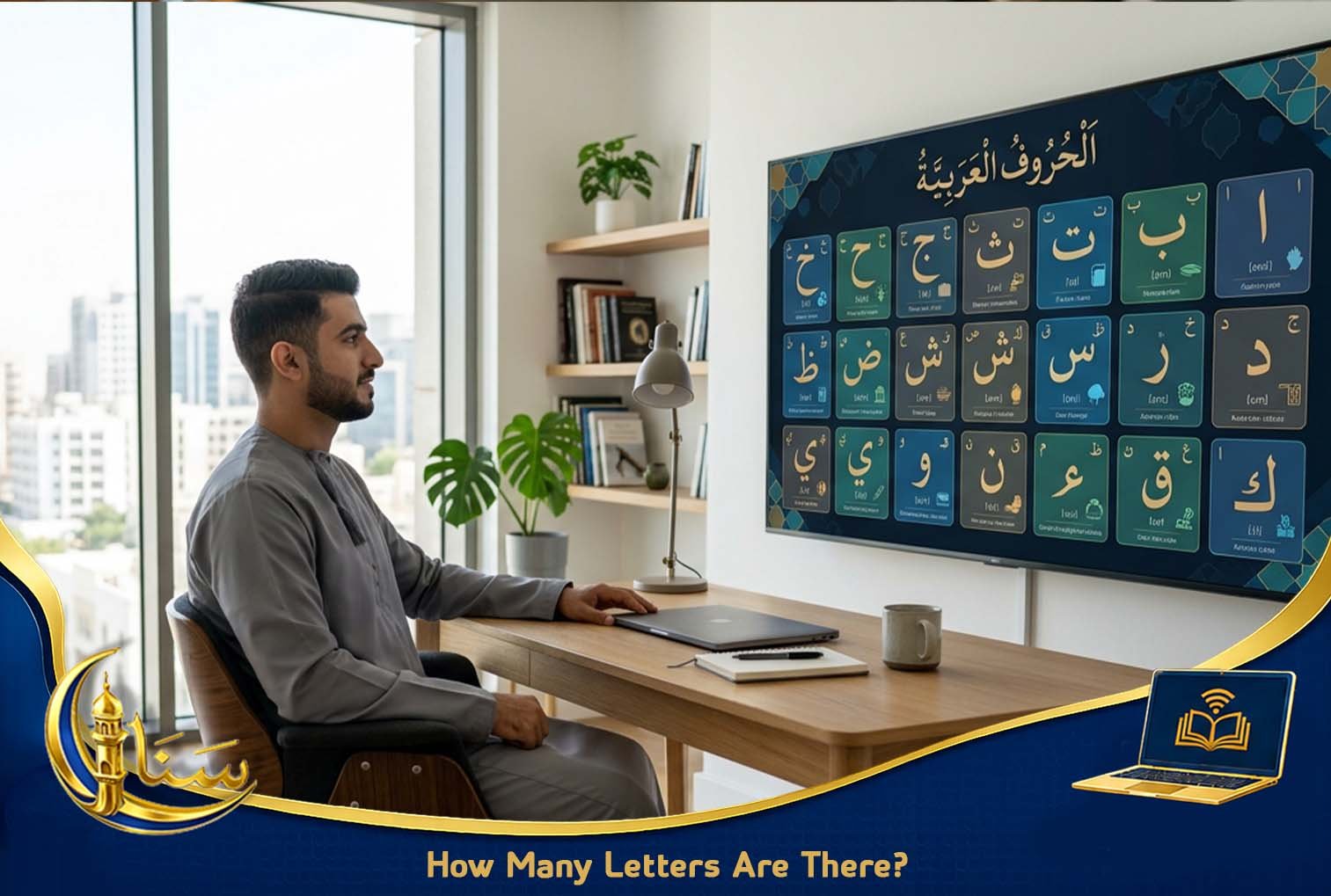
The Arabic alphabet contains 28 basic letters. This number is one of the first facts a new learner should understand because it provides a clear framework for beginning the learning process.
Although there are only 28 letters, Arabic writing can initially appear more complicated than English. The reason is that many letters have different shapes depending on whether they appear alone, at the beginning, in the middle, or at the end of a word.
For example, the letter ب is called Baa. Its basic sound is similar to the English b. However, its written form changes when it connects to other letters.
Fortunately, you do not need to memorize every possible written form separately from the beginning. Instead, start by recognizing the main letter, learning its sound, and then gradually practicing its connected forms.
The 28 letters are:
- ا — Alif
- ب — Baa
- ت — Taa
- ث — Thaa
- ج — Jeem
- ح — Haa
- خ — Khaa
- د — Daal
- ذ — Dhaal
- ر — Raa
- ز — Zaay
- س — Seen
- ش — Sheen
- ص — Saad
- ض — Daad
- ط — Taa
- ظ — Zhaa
- ع — Ayn
- غ — Ghayn
- ف — Faa
- ق — Qaaf
- ك — Kaaf
- ل — Laam
- م — Meem
- ن — Noon
- ه — Haa
- و — Waaw
- ي — Yaa
Learning these letters in a logical order is much more effective than trying to memorize the entire alphabet randomly.
Start Your Quran Learning Journey Today with Sana Online Quran Academy
Start your Quran learning journey today with Sana Online Quran Academy, where structured and simple programs are designed for both children and adults. In fact, lessons are delivered step by step by qualified teachers who focus on reading skills, basic Tajweed, and gradual improvement with clear explanations.
In addition, you can study from home with flexible schedules that fit your daily routine. Moreover, regular practice and feedback help you improve steadily. As a result, learning becomes easier, more consistent, and more effective.

Arabic Alphabet for Beginners: Letter Names and Sounds
One of the most important parts of the Arabic Alphabet for Beginners is learning the relationship between a letter’s shape and its sound. Beginners often make the mistake of focusing only on how a letter looks. However, reading requires both visual recognition and accurate pronunciation.
Some Arabic sounds are familiar to English speakers. For instance, ب sounds similar to “b,” ت resembles “t,” and م resembles “m.” Other sounds require more practice because English does not have an exact equivalent.
Here are some useful examples:
| Arabic Letter | Name | Approximate Sound |
|---|---|---|
| ا | Alif | Long “a” in certain contexts |
| ب | Baa | b |
| ت | Taa | t |
| ث | Thaa | th as in “think” |
| ج | Jeem | j in wide varieties of Arabic |
| ح | Haa | Strong breathy h |
| خ | Khaa | Similar to the sound in “Bach” |
| د | Daal | d |
| ذ | Dhaal | th as in “this” |
| ر | Raa | Tapped or rolled r |
| ز | Zaay | z |
| س | Seen | s |
| ش | Sheen | sh |
| ص | Saad | emphatic s |
| ض | Daad | emphatic consonant |
| ط | Taa | emphatic t |
| ظ | Zhaa | emphatic sound |
| ع | Ayn | deep throat sound |
| غ | Ghayn | voiced throat sound |
| ف | Faa | f |
| ق | Qaaf | deep back-of-the-mouth consonant |
| ك | Kaaf | k |
| ل | Laam | l |
| م | Meem | m |
| ن | Noon | n |
| ه | Haa | h |
| و | Waaw | w or long vowel |
| ي | Yaa | y or long vowel |
The word “approximate” is important here. Arabic pronunciation cannot always be represented accurately using English sounds. Consequently, listening to a qualified teacher can be more useful than relying entirely on English spelling.
Arabic Alphabet for Beginners: Similar Letters to Watch
Easy Arabic Words for Beginners contains several groups of letters that share similar basic shapes but differ in dots or pronunciation. This is one of the first challenges learners encounter.
For example, ب, ت, and ث have a similar base shape. Their dots distinguish them:
- ب has one dot below.
- ت has two dots above.
- ث has three dots above.
Another useful group includes ج, ح, and خ. They share a similar shape, but their dots and sounds are different:
- ج has one dot below.
- ح has no dot.
- خ has one dot above.
The same principle appears with other groups, including س and ش, as well as ص and ض.
Therefore, when practicing, do not simply memorize the general shape. Train your eyes to notice the dots as quickly as possible. At the same time, say the letter aloud so that your visual and auditory memory work together.
Understanding Letter Shapes
A major difference between Arabic and English writing is that many Arabic letters connect to neighboring letters. As a result, the same letter may look different in different positions. Most connecting letters can appear in four basic forms:
- Isolated – when the letter stands alone.
- Initial – when it appears at the beginning of a connected word.
- Medial – when it appears in the middle.
- Final – when it appears at the end.
This does not mean that you have to memorize four unrelated letters. They are different written forms of the same letter.
For example, the letter م keeps its identity and sound even though its shape can change when connected. With repeated exposure, beginners start recognizing these variations naturally.
This is why Arabic Alphabet for Beginners should include both letter recognition and connected writing. Learning isolated letters alone may help you pass the first stage, but it will not prepare you fully for reading real Arabic words.
Which Letters Do Not Connect?
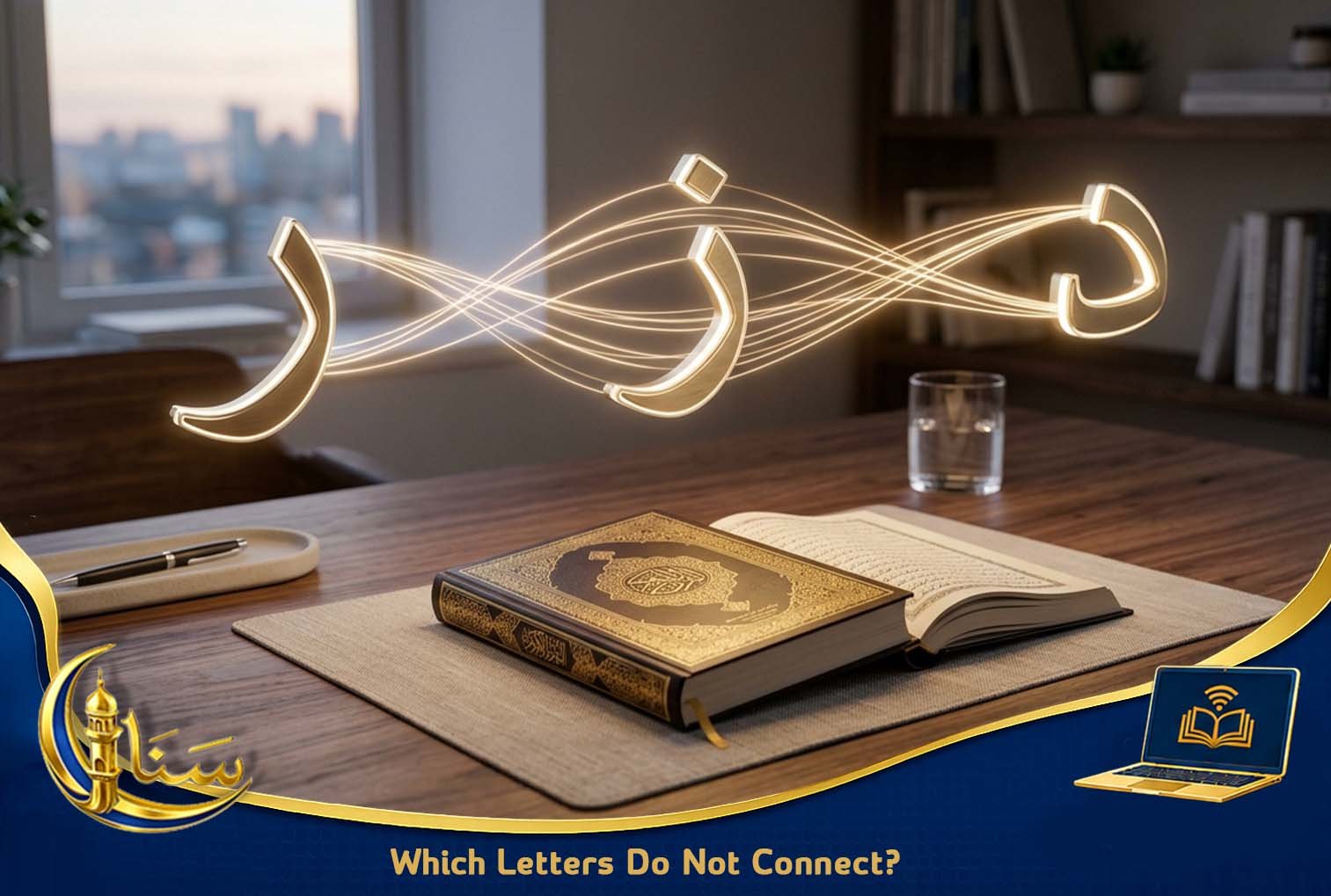
Six Arabic letters have an important special characteristic. They can connect to the letter before them, but they do not connect to the letter that follows them.
These letters are:
- ا — Alif
- د — Daal
- ذ — Dhaal
- ر — Raa
- ز — Zaay
- و — Waaw
Understanding these six letters can make Arabic spelling much less confusing.
For example, when one of these letters occurs inside a word, you may notice a visible break in the written form. That break does not necessarily mean that a new word has started. Instead, it may simply be the normal behavior of a non-connecting letter.
Beginners sometimes assume that every Arabic word should look like one continuous line. That assumption creates unnecessary confusion. Once you learn the six non-connecting letters, these breaks become much easier to recognize.
How to Pronounce Difficult Arabic Letters?
Pronunciation is often the most challenging part of learning Arabic because several Arabic sounds do not have exact English equivalents.
Letters such as ح, خ, ع, غ, ق, ص, ض, ط, and ظ may require focused practice. The difficulty is not a sign that the learner lacks ability. Instead, it simply means that the mouth and throat need to become familiar with sounds that may not exist in the learner’s first language.
For better pronunciation:
- Listen carefully before trying to imitate the sound.
- Repeat one letter several times.
- Practice the sound in short syllables.
- Record yourself when possible.
- Compare your pronunciation with a reliable teacher.
- Avoid rushing to complete the entire alphabet.
A short practice session with accurate pronunciation is more useful than a long session filled with repeated mistakes.
Arabic Alphabet for Beginners: Understanding Arabic Vowels
Arabic does not use vowels in the same way as English. Instead, short vowel sounds are commonly represented by small marks called diacritics or harakat.
The three basic short vowels are:
- Fathah (َ) — usually produces a short “a” sound.
- Dammah (ُ) — usually produces a short “u” sound.
- Kasrah (ِ) — usually produces a short “i” sound.
There are also other marks, such as sukoon (ْ) and shaddah (ّ), which provide additional information about pronunciation.
For example, placing different vowel marks on the same consonant can change how it is pronounced. Therefore, beginners should learn letters and vowel marks together once they have become comfortable identifying the basic alphabet.
This is particularly important for anyone whose goal is Quran reading because fully vowelled Arabic texts can contain pronunciation information that is not normally visible in everyday unvowelled writing.
Arabic Alphabet for Beginners: Long Vowels
Arabic also uses three letters that can function as long vowels in particular contexts:
- ا — Alif
- و — Waaw
- ي — Yaa
These letters do not always behave as vowels. Their pronunciation depends on their position and the surrounding letters. Therefore, learners should avoid assuming that every occurrence of these letters has the same sound.
A useful strategy is to first learn arabic alphabets their consonant functions and then study its long-vowel roles with simple examples.
For instance, و can represent a consonant similar to “w,” but in other contexts it can participate in a long vowel sound. Similarly, ي can represent “y” or contribute to a long “ee” sound.
Understanding this distinction helps learners progress from simply identifying letters to actually reading words.
Why Does Arabic Writing Go From Right to Left?
Another important feature of the Arabic Alphabet for Beginners is learning the direction of writing. Arabic is written from right to left, unlike English, which is normally written from left to right. This difference may feel unusual during the first few lessons.
However, the direction quickly becomes more natural when you practice consistently. When reading an Arabic word, begin from the rightmost side and move toward the left. When writing, start on the right and continue toward the left.
Children and adults may initially reverse the direction because they are transferring habits from English. Instead of treating this as a serious problem, practice short words repeatedly until the movement becomes automatic.
How Letters Connect?
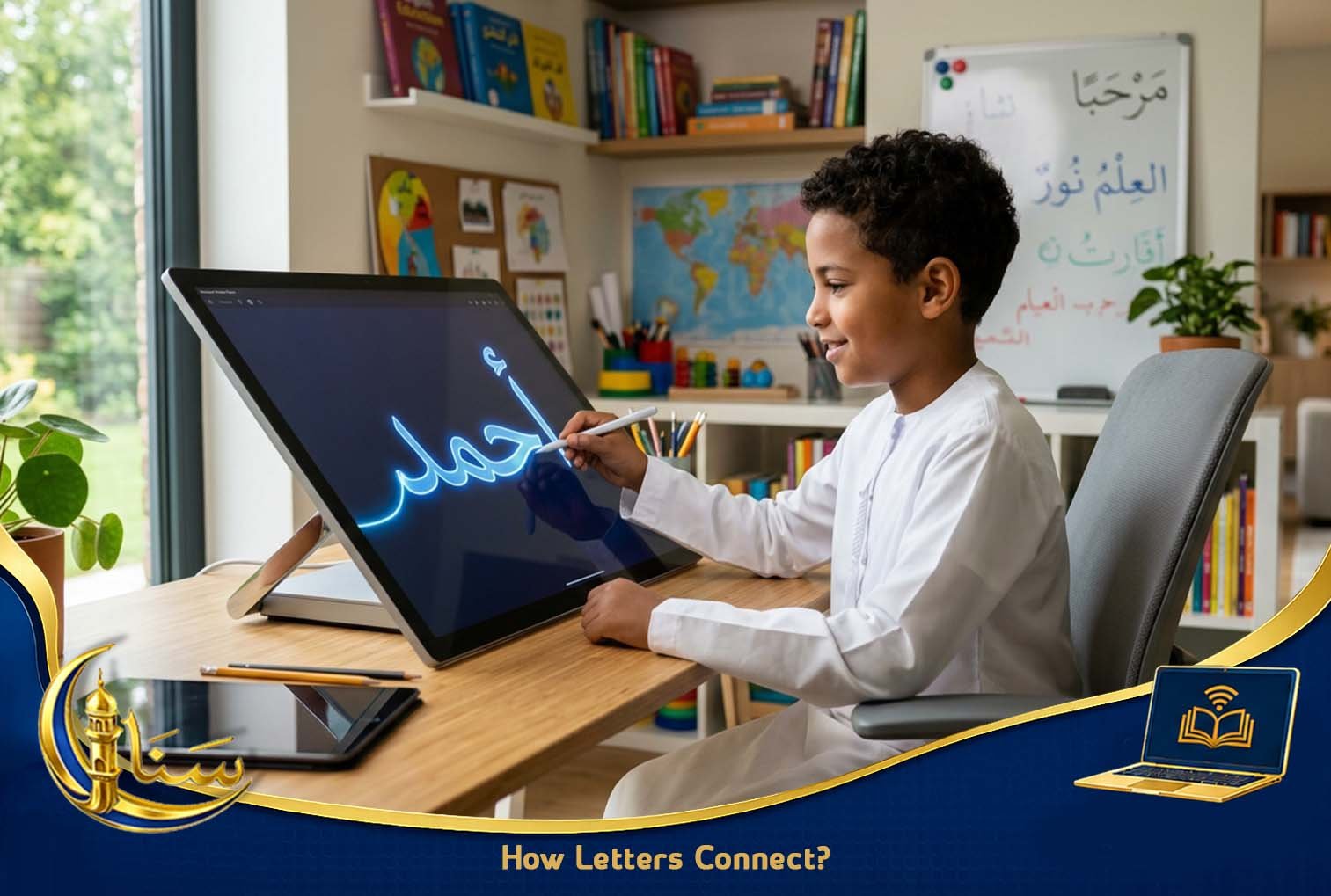
Learning individual letters is only the first step. The next stage is understanding how they combine to create words.
Consider the Arabic word كتاب, meaning “book.” It consists of four letters:
ك + ت + ا + ب
When written as a complete word, however, the letters appear connected according to Arabic writing rules.
This is why Arabic Alphabet for Beginners should move gradually from isolated letters to simple combinations. If a learner memorizes the alphabet but never practices connected forms, reading ordinary Arabic text can still feel difficult. A practical progression is:
- Recognize individual letters.
- Identify letters with similar shapes.
- Learn the six non-connecting letters.
- Practice initial and final forms.
- Practice medial forms.
- Read short combinations.
- Move to simple words.
- Gradually increase reading difficulty.
This sequence reduces cognitive overload and gives the learner a clear sense of progress.
How to Practice Writing Arabic Letters?
Writing is an excellent way to strengthen letter recognition. When you write a letter by hand, you use visual, physical, and memory-based skills at the same time.
Start with large, simple letter shapes. Focus on direction, proportions, dots, and connections rather than speed. A beginner can use the following routine:
- Write each new letter five to ten times.
- Say its name while writing it.
- Pronounce its sound after finishing each line.
- Practice letters with similar shapes together.
- Copy short combinations.
- Review older letters before introducing new ones.
Do not worry if your handwriting looks imperfect at first. Arabic handwriting improves through repetition. Moreover, the goal of the first stage is recognition and control, not artistic calligraphy.
Arabic Alphabet for Beginners: A Simple Daily Practice Plan
A consistent routine is more effective than studying the alphabet for several hours once a week.A beginner can divide practice into short sections:
5 Minutes: Letter Recognition
Review previously learned letters. Cover the names and try to identify each symbol independently.
5 Minutes: Pronunciation
Choose several letters and pronounce them carefully. Give extra attention to sounds that are unfamiliar.
5 Minutes: Writing
Write the selected letters repeatedly. Practice both isolated and connected forms when appropriate.
5 Minutes: Reading
Use simple combinations or short Arabic words. Read slowly from right to left.
As your confidence grows, you can extend the session. Nevertheless, consistency remains more important than studying for a very long time on only one day.
Common Mistakes Beginners Make
Many learners experience similar problems when they begin studying Arabic letters. Fortunately, recognizing these mistakes early can save time and make the learning process much easier.
Memorizing Shapes Without Sounds
A learner may recognize ب visually but hesitate when asked to pronounce it. Therefore, it is important to connect each letter’s shape with its correct sound from the beginning. In addition, saying the letter aloud while looking at it can strengthen both visual and auditory memory.
Ignoring the Dots
Dots are not decorative. In fact, they can completely change the identity of an Arabic letter. For this reason, beginners should pay close attention to the number and position of every dot. For example, ب, ت, and ث have similar basic shapes, but their dots distinguish them from one another.
Learning Only Isolated Letters
A learner may recognize all 28 isolated Arabic letters yet still find it difficult to read complete words. This is a natural part of the learning process and does not indicate that the alphabet was learned incorrectly.
Instead, learners should gradually become familiar with connected letter forms and understand how letters change when they appear at the beginning, middle, or end of a word.
Choosing the right learning environment can also make this transition easier, so exploring How to Choose the Best Online Arabic Academy can help learners find suitable guidance for developing their Arabic reading skills.
Relying Only on English Pronunciation
English spelling cannot represent every Arabic sound accurately. Consequently, using English pronunciation as the only guide can lead to incorrect habits. At first, transliteration may help temporarily. Nevertheless, beginners should gradually depend on the Arabic letters themselves and listen to accurate pronunciation.
Studying Too Many Letters at Once
Trying to memorize the entire alphabet in one sitting can cause unnecessary confusion. Instead, study a small group of letters and review them before adding new ones. Furthermore, grouping letters according to their shapes or sounds can make memorization easier. Therefore, a gradual learning schedule is usually more effective than attempting to memorize everything at once.
How to Remember Letters Faster?
Memory becomes stronger when learners use several learning methods rather than relying on repetition alone. For this reason, combine visual recognition, pronunciation, writing, and regular review.
One effective approach is grouping letters according to visual similarity. For example, study ب, ت, and ث together because they share a similar basic shape. Then, compare their dots and sounds carefully. This approach helps learners notice the small differences that identify each letter.
You can also create personal associations. For instance, connect a letter with a familiar Arabic word, image, or sound. Moreover, saying the letter aloud while writing it creates another memory pathway. As a result, you are not depending on visual memory alone.
Spaced review is equally valuable. Instead of learning something once and never returning to it, review the material after a short interval. Then, review it again later in the week. Over time, this repeated exposure makes recognition faster and more automatic.
A useful cycle is:
- Learn a small group of letters.
- Then, review them on the same day.
- Afterward, review them again the next day.
- Next, test your memory several days later.
- Finally, practice identifying the letters without looking at the answers.
By following this process, learners can gradually move information from short-term recognition toward long-term recall.
Arabic Alphabet for Beginners: From Letters to Words
The ultimate goal of learning the alphabet is not simply to name letters. Instead, the goal is to use them to read meaningful Arabic words.
Once you can recognize individual letters, begin reading short combinations. At first, choose words that contain familiar letters and simple vowel patterns. This way, you can focus on connecting letters without becoming overwhelmed by unfamiliar vocabulary.
For example, learners can practice breaking a word into its individual components before reading it as a whole. Then, they can look at the connected word and identify the same letters within it. As a result, the brain gradually learns the relationship between separate letters and connected Arabic script.
With regular practice, you will stop processing every letter individually. Instead, common patterns and short words will begin to look familiar. Eventually, reading becomes less dependent on conscious letter-by-letter decoding.
That transition is an important milestone. In other words, it shows that your reading ability is becoming more automatic and that the alphabet is beginning to function as a practical reading system.
Learning Arabic Letters for Quran Reading
For Muslims who want to read the Quran, learning Arabic letters is a foundational step. However, recognizing the alphabet is only the beginning. Quranic reading also requires familiarity with vowel marks, accurate pronunciation, and eventually Tajweed principles.
First, the main objective should be accurate letter recognition. After that, learners can work on combining letters and reading vowelled words. Then, they can gradually improve pronunciation and begin applying basic reading rules.
A structured learning environment can be especially useful because a teacher can identify mistakes that beginners may not notice themselves. For example, a student might confuse two similar letters or produce a sound incorrectly without realizing it.
In this situation, immediate correction can prevent the mistake from becoming a habit. Therefore, guided practice can make the learning process more efficient.
Sana Online Quran Academy, the best online Arabic Academy for beginners, can provide structured support for learners who want to develop their Arabic reading foundation as part of their Quran learning journey. Rather than rushing through the alphabet, students can build their skills gradually and strengthen weak areas through guided practice.
How Can Sana Online Quran Academy Support Beginners?
Choosing the right learning environment can make the first stage of Arabic study more comfortable. In particular, beginners often need clear explanations, repeated practice, and useful feedback when a sound or letter shape seems confusing.
With Sana Online Quran Academy, learners can approach Arabic reading as a gradual skill rather than a simple memorization challenge. For example, a structured lesson can help students understand what to practice first and what they should study next.
For children, short and engaging activities can make letter learning easier to maintain. Meanwhile, adults may benefit from a more systematic approach that connects alphabet recognition with specific reading goals.
Most importantly, learners should have an opportunity to ask questions. A confusing letter should not remain difficult for several weeks when a teacher can explain the difference immediately. As a result, regular feedback can help learners correct mistakes before they become deeply established.
What Should You Learn After the Letters?
Once you have learned the alphabet, your studies should not stop. Instead, the next stage should match your personal learning goal.
If your goal is general Arabic reading, you can gradually move toward:
- Basic vocabulary.
- Common Arabic words.
- Simple sentence patterns.
- Everyday expressions.
- Short reading passages.
- Basic grammar.
On the other hand, if your goal is Quran reading, the progression can include:
- Arabic vowel marks.
- Letter combinations.
- Quranic words.
- Pronunciation practice.
- Basic Tajweed.
- Gradual Quran reading.
In either case, the important point is to build each skill on the previous one. For example, strong letter recognition makes it easier to identify words, while accurate pronunciation provides a stronger foundation for later Quran reading.
Therefore, do not feel pressured to study advanced topics before your alphabet skills are secure. A strong foundation can make the next stages much easier.
Arabic Alphabet for Beginners: How Long Does It Take?
There is no universal timeline for mastering the Arabic alphabet. For some learners, recognizing the basic letters may take only a few days. For others, several weeks of regular practice may be necessary.
Generally, the difference depends on previous language experience, study frequency, age, pronunciation challenges, and the amount of practice outside lessons. Therefore, comparing your progress with another learner may not provide a useful measurement.
Instead of asking whether you can finish the alphabet quickly, focus on whether you can:
- Recognize letters without hesitation.
- Also, distinguish similar letters.
- Pronounce basic sounds correctly.
- Identify connected forms.
- Read simple combinations.
- Write common letters accurately.
Once these skills become more familiar, you are ready to move forward. At that point, learning new vocabulary and reading longer words becomes much more manageable.
How to Make Arabic Alphabet Practice More Enjoyable?
Learning becomes easier when practice feels purposeful. Rather than repeating isolated symbols for a long period, connect each lesson with a practical objective.
For example, you can spend one session identifying letters, another practicing pronunciation, and another reading simple words. This variety prevents practice from becoming monotonous and gives you several ways to reinforce the same skill.
Children may enjoy:
- Letter cards.
- Matching activities.
- Writing games.
- Short pronunciation exercises.
- Reading challenges.
- Visual comparisons between similar letters.
Meanwhile, adults can use labels, beginner reading materials, handwriting exercises, and short daily review sessions.
Additionally, celebrating small improvements can maintain motivation. Recognizing five new letters correctly is progress. Likewise, reading your first complete Arabic word is another meaningful achievement.
Over time, these small successes can make the learning journey feel more manageable. Consequently, learners are more likely to maintain a consistent practice routine.
Arabic Alphabet for Beginners: Final Learning Tips
The Arabic alphabet becomes much less intimidating when it is divided into manageable skills. Fortunately, you do not need to understand every aspect of Arabic grammar before learning to read. Instead, concentrate on one foundation at a time.
Keep these principles in mind:
- First, learn the 28 basic letters.
- Next, pay close attention to dots.
- Then, practice pronunciation from the beginning.
- After that, learn the right-to-left writing direction.
- Also, understand connected letter forms.
- Furthermore, memorize the six non-connecting letters.
- Later, study short vowel marks.
- Meanwhile, read simple combinations regularly.
- In addition, review older material frequently.
- Finally, ask a teacher to correct pronunciation.
Most importantly, do not confuse difficulty with inability. Some Arabic sounds and letter forms may feel unfamiliar simply because your eyes, hands, and mouth have not practiced them enough yet.
With regular exposure, what initially looks complicated can become recognizable and predictable. As your confidence increases, you will begin to recognize patterns more quickly and read with less hesitation.
Building Confidence With Sana Online Quran Academy

A beginner-friendly learning plan should provide more than a list of letters. Instead, students need progression, correction, repetition, and opportunities to apply what they have learned.
Sana Online Quran Academy can be part of that process for learners who want structured online instruction. By beginning with letter recognition and pronunciation, students can establish a foundation for later Quran reading skills.
The most effective approach is usually steady rather than rushed. For example, a learner who practices consistently and corrects mistakes early is more likely to develop confidence than someone who tries to memorize everything during a single session.
Furthermore, regular lessons can provide a clear sense of direction. Students know what they have already learned, what they need to review, and what skill comes next.
For this reason, Online Arabic Academy vs Traditional Classes can be a useful option for students who prefer guided learning while developing their Arabic reading foundation. Ultimately, consistent practice, accurate pronunciation, and gradual progression can turn the first Arabic letters into a strong foundation for further learning.
Frequently Asked Questions: Arabic Alphabet for Beginners
Finally, these frequently asked questions address some practical concerns beginners may have while starting their Arabic alphabet learning journey.
1. Can I learn Arabic letters if I cannot speak Arabic?
Yes. You can learn to recognize and pronounce the Arabic alphabet without first being able to hold a conversation in Arabic. Reading and speaking are related skills, but they can be developed separately at the beginning.
2. Should I learn Arabic handwriting or printed Arabic first?
For most beginners, recognizing standard printed Arabic first is practical because it makes it easier to read books, learning materials, websites, and Quranic text. Handwriting can then be developed alongside reading as your confidence increases.
3. Is transliteration a good long-term way to learn Arabic pronunciation?
Transliteration can help during the earliest stages, but it should not become a permanent substitute for learning Arabic letters and sounds. Some Arabic sounds cannot be represented accurately with English letters, so relying exclusively on transliteration can create pronunciation problems later.
4. Can learning the Arabic alphabet help me learn other languages?
It can make it easier to recognize scripts used by some languages that employ Arabic-derived writing systems. However, each language has its own spelling conventions, sounds, and vocabulary, so knowing Arabic letters does not automatically mean you can read every related script.
In conclusion, learning the alphabet is the first major step toward Arabic reading. The 28 letters may look unfamiliar at first, but their patterns become easier to recognize through regular practice. Once you understand letter shapes, dots, pronunciation, connections, and vowel marks, you can gradually move from individual symbols to complete words.
The key is to avoid rushing. Arabic Alphabet for Beginners should be approached as a progressive learning journey in which every new skill supports the next one. Start with recognition, add pronunciation, practice writing, understand connections, and then begin reading simple words.
For learners who want guidance while developing their Arabic and Quran reading foundation, Sana Online Quran Academy offers a structured environment in which beginners can work on these essential skills step by step.
With patience, consistent practice, and accurate instruction, the Arabic alphabet can move from something unfamiliar to a practical foundation for reading Arabic with confidence.