
The best Arabic Learning Tips for Beginners can make the difference between studying Arabic randomly and building a clear learning routine that gradually develops vocabulary, pronunciation, reading, listening, and conversation skills. Starting a new language may feel difficult at first, especially when the learner is unfamiliar with the Arabic alphabet, sounds, sentence structure, or the differences between formal Arabic and spoken varieties.
However, beginners do not need to master everything at once. A practical approach begins with understanding the learner’s current level, choosing suitable learning materials, setting realistic goals, and practicing consistently. Instead of trying to memorize large amounts of information in a short period, it is more useful to create a routine that combines several skills and gives each one enough attention.
For learners who prefer guided instruction, Sana Online Quran Academy can provide a structured environment in which Arabic learning can be approached gradually alongside the learner’s broader Quranic and Islamic studies. The important point is to select a learning method that matches the learner’s needs rather than following a routine simply because it works for someone else.
Why Beginners Need a Clear Arabic Learning Strategy?

Arabic has several features that can seem unfamiliar to someone who has never studied the language. The writing system runs from right to left, letters can change shape according to their position in a word, and some Arabic sounds may not exist in the learner’s first language.
Consequently, beginners can become frustrated when they expect immediate fluency. A better strategy is to divide the learning process into manageable stages. Each stage should have a specific purpose and should build naturally on what came before it. A useful beginner strategy can include:
- Learning the Arabic alphabet and basic letter forms.
- Understanding short and long vowel sounds.
- Building a practical everyday vocabulary.
- Learning simple sentence patterns.
- Listening to clear Arabic regularly.
- Practicing pronunciation rather than only reading silently.
- Reviewing older vocabulary before introducing too many new words.
- Using Arabic in short conversations as soon as possible.
These steps create a foundation that makes later grammar and communication practice easier. More importantly, they prevent the learner from spending most of the study time on memorization without knowing how the language is actually used.
Start Your Quran Learning Journey Today with Sana Online Quran Academy
Start your Quran learning journey today with Sana Online Quran Academy, where structured and simple programs are designed for both children and adults. In fact, lessons are delivered step by step by qualified teachers who focus on reading skills, basic Tajweed, and gradual improvement with clear explanations.
In addition, you can study from home with flexible schedules that fit your daily routine. Moreover, regular practice and feedback help you improve steadily. As a result, learning becomes easier, more consistent, and more effective.

Best Arabic Learning Tips for Beginners: Start With the Right Level
One of the most useful Best Arabic Learning Tips for Beginners is to avoid choosing materials simply because they appear advanced or comprehensive. A beginner needs resources that match their actual ability.
Someone who cannot yet recognize Arabic letters needs a different starting point from a learner who can read Arabic but struggles to understand conversations. Similarly, a person who understands written Arabic may require more speaking practice rather than another introductory alphabet lesson. Before selecting a course or textbook, consider questions such as:
- Can you recognize and pronounce the Arabic alphabet?
- Can you read words with basic vowel markings?
- How many common Arabic words do you understand?
- Can you introduce yourself in Arabic?
- Can you understand very simple spoken phrases?
- Are you learning for conversation, reading, Quranic studies, travel, work, or another purpose?
Once the starting point is clear, the learning path becomes much easier to organize. Sana Online Quran Academy can be considered by learners who want guided online instruction and prefer studying from home rather than relying entirely on independent resources.
Avoid Studying Material That Is Too Difficult
Advanced material may look impressive, but it can slow beginners down when the vocabulary and grammar are far beyond their current level. Instead, choose lessons where most of the content is understandable while still introducing a small amount of new information. That balance allows learners to notice progress without feeling overwhelmed.
Best Arabic Learning Tips for Beginners: Learn the Alphabet Properly
The Arabic alphabet is the foundation for reading and writing. Therefore, rushing through it can create difficulties later. Beginners should become familiar with each letter’s sound, shape, and position within a word.
Arabic letters can appear differently depending on whether they occur at the beginning, middle, or end of a word. This feature may initially seem confusing, but repeated exposure makes the patterns easier to recognize.
Rather than memorizing the letters visually only, connect each letter with its sound. Reading aloud can also help reinforce the relationship between what you see and what you pronounce. A simple practice session might include:
- Reviewing five to ten letters.
- Saying their sounds aloud.
- Writing each letter several times.
- Reading short combinations.
- Returning to previously learned letters.
- Testing recognition without looking at the answer.
This method creates active recall instead of passive recognition. As a result, learners gradually become more comfortable reading unfamiliar words.
Understand Arabic Sounds Before Focusing on Speed
Pronunciation deserves attention from the beginning because some Arabic sounds require mouth and tongue positions that may feel unfamiliar. Learners should not worry about sounding perfect immediately. Instead, they should aim to hear the difference between similar sounds and gradually reproduce them more accurately.
Listening carefully is particularly important. When a teacher pronounces a word, notice where the sound comes from and how the mouth moves. Then repeat it slowly before attempting normal speed.
At this stage, recording your own pronunciation can also be useful. Comparing your recording with a reliable pronunciation model may reveal sounds that you did not notice while speaking.
Most importantly, correction should be treated as part of learning rather than as evidence of failure. Small pronunciation improvements accumulate over time.
Build a Practical Arabic Vocabulary
Another important part of Best Arabic Learning Tips for Beginners is learning vocabulary according to usefulness rather than choosing words randomly.
A beginner does not need thousands of isolated words immediately. It is more productive to learn vocabulary that can be used in simple situations and then place those words into sentences. For example, vocabulary can be organized around themes such as:
- Family and relationships
- Numbers and time
- Food and drinks
- Home and daily activities
- School and learning
- Work and common occupations
- Places and directions
- Greetings and introductions
- Common questions
- Frequently used verbs
Learning words in groups makes them easier to connect. Furthermore, vocabulary becomes more memorable when learners see it in context.
Instead of memorizing a word alone, create a short sentence with it. This approach teaches both the meaning of the word and one way it behaves within an Arabic sentence.
Use Active Recall Instead of Repeated Reading
Reading the same vocabulary list several times may create a temporary feeling of familiarity. However, trying to remember the meaning without looking at the answer provides stronger practice.
Flashcards can help with this process. The front might contain an Arabic word, while the learner attempts to remember the meaning before checking the back.
Short review sessions are usually easier to maintain than occasional long sessions. For that reason, ten focused minutes every day can be more useful than one large vocabulary session followed by several days without practice.
Best Arabic Learning Tips for Beginners: Practice Reading Every Day
Reading Arabic regularly helps beginners become familiar with letter patterns, vocabulary, vowel marks, and sentence structure. The material should be short enough to understand rather than so difficult that every sentence requires extensive translation. Start with:
- Individual words.
- Very short sentences.
- Simple dialogues.
- Children’s educational texts.
- Short passages with familiar vocabulary.
- Gradually longer texts as comprehension improves.
Reading aloud adds another benefit because it combines visual recognition with pronunciation. At the same time, silent reading can help learners focus on comprehension.
Do not stop at every unfamiliar word. First, try to understand the general meaning from context. Then check only the words that are important for understanding the passage. This habit helps learners become less dependent on translation tools.
Improve Listening With Short and Clear Arabic Content

Listening is often neglected by beginners because reading feels easier. Nevertheless, spoken Arabic develops differently from written Arabic. Learners need regular exposure to natural pronunciation, rhythm, pauses, and connected speech.
One of the most effective Arabic Learning Tips for Beginners is to begin with short audio rather than forcing yourself to understand long conversations. A useful listening routine could look like this:
- First listen: Focus on the overall meaning.
- Second listen: Identify familiar words.
- Third listen: Notice pronunciation and sentence patterns.
- Final step: Repeat selected phrases aloud.
Do not expect to understand every word. The purpose of early listening practice is to train the ear gradually.
As comprehension improves, the learner can move from slow educational recordings toward more natural conversations.
Learn Arabic Through Sentences, Not Isolated Words
Words become significantly more useful when learners understand how they function in sentences. Therefore, vocabulary study should eventually move beyond lists.
Suppose a learner studies a word related to food. Instead of memorizing only its translation, the learner can practice a simple sentence containing that word. Then another sentence can change the subject, verb, or context.
This method exposes learners to grammatical patterns without requiring them to memorize every grammar rule immediately. For example, beginners can gradually notice:
- How nouns behave in simple sentences.
- Where adjectives appear.
- How questions are formed.
- How common verbs change.
- How pronouns affect sentences.
- How singular and plural forms differ.
With repeated exposure, these structures become increasingly familiar.
Best Arabic Learning Tips for Beginners: Develop Speaking Confidence
Speaking can be intimidating, particularly when beginners believe every sentence must be grammatically perfect. In reality, early speaking practice should focus on communication and gradual correction.
Start with predictable situations. Practice introducing yourself, asking simple questions, describing your day, talking about family, and expressing basic needs.
A learner might begin with short exchanges and then gradually extend them. For example, one question can lead to a one-sentence answer, followed by a second question and a longer response.
Speak Before You Feel Completely Ready
Waiting until you know enough vocabulary can delay speaking indefinitely. Instead, use the language you already know.
If you know ten useful words, find several ways to use them. If you know five sentence patterns, practice changing the nouns and verbs within those patterns.
This approach creates flexibility. It also teaches learners that communication does not require knowing every possible word.
A supportive teacher can make this process easier by correcting important errors while allowing the learner enough space to speak. Sana Online Quran Academy may be relevant for students seeking an online learning setting where instruction can be combined with regular practice.
Choose Learning Materials Carefully
The internet provides an enormous amount of Arabic-learning content. While this accessibility is useful, it can also create confusion.
Beginners may jump between videos, applications, websites, social media accounts, textbooks, and unrelated courses. Consequently, they may spend more time deciding what to study than actually studying. A better approach is to create a small core resource system. Choose:
- One primary course or structured learning path.
- One vocabulary review method.
- One reliable listening source.
- One reading source appropriate to your level.
- One way to practice speaking.
Additional resources can be added later when there is a clear reason to use them.
The objective is not to collect the largest number of resources. Instead, it is to create a routine that can be followed consistently.
Best Arabic Learning Tips for Beginners: Create a Realistic Routine
Consistency is one of the most practical Best Arabic Learning Tips for Beginners because language development depends heavily on repeated exposure.
A realistic routine is usually better than an ambitious schedule that becomes difficult to maintain. Beginners should consider their available time and choose a pattern that fits their daily life. For example, a weekly routine might include:
- 10 minutes: vocabulary review.
- 15 minutes: reading.
- 15 minutes: listening.
- 15 minutes: speaking or pronunciation.
- One or two longer sessions: guided lessons and focused practice.
The exact schedule can vary. What matters is maintaining regular contact with Arabic.
Even on busy days, a short review can keep the learning habit active. When more time becomes available, the learner can complete a longer lesson.
Combine Guided Lessons With Independent Practice
Lessons provide structure, explanation, correction, and interaction. Independent study, on the other hand, gives learners additional opportunities to review and apply what they learned. The two approaches work best together.
During a lesson, a learner may encounter a new grammatical structure. Later, independent practice can reinforce that structure through reading, writing, listening, or conversation. This cycle creates a useful learning pattern:
Learn → Practice → Review → Use → Correct → Repeat
Rather than expecting one lesson to produce permanent mastery, treat each lesson as one stage in a longer process.
For learners who prefer structured online support, Sana Online Quran Academy can form part of a broader learning routine, particularly when Arabic practice is connected with Quranic reading or Islamic learning goals.
Use Technology Without Letting It Control Your Study
Technology can make Arabic practice more accessible. Learners can use digital dictionaries, flashcards, audio recordings, educational videos, and online lessons from almost anywhere. Nevertheless, technology should serve the learning plan rather than replace it.
For example, an application may be useful for vocabulary review, while a teacher provides pronunciation correction. Audio content can strengthen listening, while reading materials improve recognition and comprehension.
The most useful question is not “Which app should I use?” but “What skill am I trying to improve?”Different learning challenges require different types of practice. Vocabulary difficulties can be addressed with a dedicated vocabulary tool and regular review.
When pronunciation needs improvement, focus more on listening exercises and speaking practice. For slower reading skills, increase the amount of time spent reading short and appropriate Arabic texts. That simple distinction prevents learners from using the same tool for every learning problem.
Best Arabic Learning Tips for Beginners: Practice Outside the Lesson
One of the Best Arabic Learning Tips for Beginners is to treat lessons as the beginning of practice rather than their entire duration.
Arabic improves when the learner encounters it repeatedly throughout the week. Therefore, small activities outside formal lessons can have considerable value. If you are still deciding where to begin, How to Start Learning Arabic can help you understand the basic stages involved in developing your language skills. Try simple habits such as:
- Labeling familiar household objects in Arabic.
- Saying basic actions aloud.
- Listening to Arabic while following a transcript.
- Reviewing vocabulary during short breaks.
- Writing a few Arabic sentences each evening.
- Practicing introductions and common questions.
- Repeating phrases from lessons.
- Reading short Arabic passages aloud.
These activities do not need to take an hour. Their purpose is to increase meaningful exposure.
Over time, everyday repetition can make Arabic feel less unfamiliar and reduce the mental effort required to recognize common expressions.
Ask for Help When You Reach a Difficult Point

Independent learning has clear advantages, but beginners can sometimes spend weeks repeating the same mistake without realizing it. A teacher or experienced tutor can identify problems that may be difficult to notice independently. Support can be particularly valuable when:
- Pronunciation remains difficult.
- Grammar explanations are confusing.
- Reading progress has stopped.
- The learner cannot identify why sentences sound incorrect.
- Speaking confidence remains low.
- Study materials no longer match the learner’s level.
Asking for clarification is not a weakness. In fact, targeted feedback can save time by addressing the actual problem instead of encouraging the learner to repeat ineffective practice.
Sana Online Quran Academy can be incorporated into a guided learning approach for students who value teacher-led instruction and online accessibility.
Track Progress Without Obsessing Over Perfection
Progress in language learning is not always obvious from day to day. A learner may feel stuck for several weeks and then suddenly realize that a previously difficult passage has become easier. Keeping a simple record can make improvement more visible. Track areas such as:
- Number of new words understood.
- Reading speed.
- Ability to understand short recordings.
- Number of sentences spoken independently.
- Pronunciation improvements.
- Grammar patterns recognized.
- Ability to complete basic conversations.
Monthly comparisons are often more meaningful than daily judgments. The goal is not to become perfect immediately. Instead, look for evidence that comprehension, accuracy, confidence, and independence are gradually improving. Understanding How Long It Does Take to Speak Arabic can also help learners set realistic expectations about speaking development.
Common Mistakes Beginners Should Avoid
Even a well-designed learning routine can become less effective when beginners fall into common habits.
- Studying Too Much at Once
Large amounts of information can quickly become overwhelming. Smaller lessons followed by review usually make the material easier to retain. - Memorizing Without Context
A long list of translated words does not automatically create communication skills. Vocabulary should eventually be used in sentences and conversations. - Ignoring Pronunciation
Reading silently cannot fully develop speaking ability. Regular listening and repetition should therefore be part of the routine. - Changing Resources Constantly
Moving from one course to another may prevent learners from completing a coherent progression. Give a suitable learning path enough time before replacing it. - Waiting for Perfect Grammar
Speaking only after achieving grammatical perfection can delay practical communication. Beginners should speak with the language they currently possess and improve through correction. - Comparing Your Progress With Others
Every learner has a different background, schedule, language experience, and learning objective. Personal progress provides a more useful reference point than someone else’s timeline. For children, parents can also explore Fun Ways Kids Can Learn Arabic to make practice more engaging.
Best Arabic Learning Tips for Beginners: Make Learning Sustainable
The most successful routine is not necessarily the most intensive one. It is the routine that can continue for months without becoming exhausting.
For that reason, learners should think about sustainability. A schedule that requires two hours every day may work temporarily, but a shorter routine may be more practical for someone with work, family, or school responsibilities.
Keep the process varied. One day can emphasize listening, another can focus on reading, while a lesson can combine several skills. A structured approach such as Learn Arabic Online Step by Step can help learners organize these activities and develop their skills gradually.
Additionally, celebrate practical milestones. Understanding a short conversation, reading a complete paragraph, or introducing yourself without translation are meaningful achievements.
These small successes create motivation because the learner can see the language becoming more useful.
How Can Sana Online Quran Academy Support Arabic Learning?
Sana Online Quran Academy can be relevant to learners who want online instruction within a structured educational setting. For beginners, guided learning can help turn scattered practice into a clearer progression.
Rather than relying entirely on independent study, learners can use instruction to understand concepts and then reinforce them through personal practice.
An online learning environment can also be convenient for students who prefer studying from home. The value of any learning program, however, depends on whether its teaching approach, schedule, content, and level match the individual learner’s goals.
Before beginning, identify what you actually want to accomplish. Someone focusing on basic Arabic reading may need a different learning path from someone primarily interested in conversation.
Build a Personal Learning Plan
A practical plan can combine guided lessons with independent work, allowing learners to benefit from teacher support while also having enough time to review, practice, and apply what they learn on their own.
- Identify your current Arabic level.
- Define one or two specific learning goals.
- Select suitable instructional support.
- Create a weekly study schedule.
- Practice vocabulary in context.
- Include listening and speaking regularly.
- Review older material.
- Track progress each month.
- Adjust difficult areas instead of abandoning the entire plan.
This structure keeps the learner focused while still allowing flexibility. When comparing different study approaches, Best Way to Learn Arabic Online can provide additional guidance for choosing a method that fits your goals, schedule, and preferred learning style.
A Simple 30-Day Approach
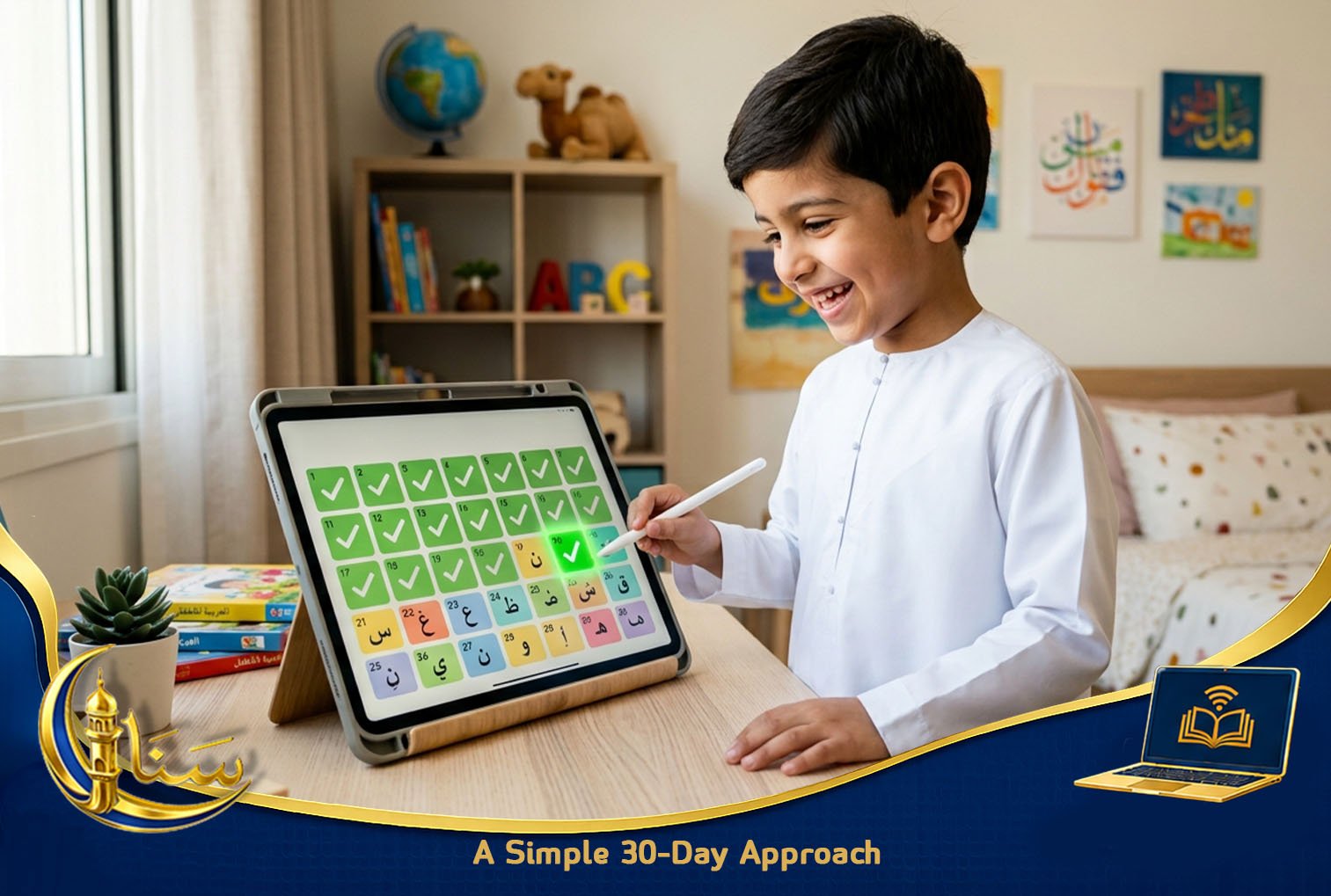
Beginners who are unsure where to start can divide their first month into manageable stages.
- Week One: Build the Foundation
Focus on the alphabet, sounds, basic reading patterns, greetings, introductions, and a small set of everyday words. The goal is familiarity rather than speed. - Week Two: Add Simple Sentences
Begin working with basic sentence structures. Practice introducing yourself, describing familiar objects, and asking simple questions. At the same time, continue reviewing the alphabet and vocabulary from the first week. - Week Three: Increase Listening and Speaking
Introduce short audio recordings and repeat useful phrases. Practice answering simple questions without translating every word mentally. This stage should encourage active language use. - Week Four: Combine the Skills
Use short reading passages, listening exercises, vocabulary review, and simple conversations together.
At the end of the month, compare your ability with your starting point. Identify what has improved and which skill requires additional attention. This approach makes the learning journey measurable without turning it into a race.
Frequently Asked Questions
Beginners often have questions about learning Arabic, including how to study, practice new skills, choose useful resources, and build confidence. These answers offer practical guidance for starting Arabic learning effectively and maintaining steady progress.
1. Should beginners learn Modern Standard Arabic or a spoken dialect first?
The answer depends on the learner’s purpose. Modern Standard Arabic is useful for formal written and spoken contexts, while dialects are commonly used in everyday conversations. Someone planning to communicate mainly in a specific Arab country may eventually need exposure to its local dialect.
2. How can I remember Arabic words that I keep forgetting?
Use spaced review and place unfamiliar words into short sentences. Connecting vocabulary with a situation, image, phrase, or personal example can make recall easier than repeatedly reading a translation list.
3. Is it possible to learn Arabic without knowing English?
Yes. Arabic can be taught through Arabic itself, visual explanations, demonstrations, repetition, and the learner’s preferred instructional language. The appropriate method depends on the student’s level and available learning support.
4. When should an Arabic beginner start writing paragraphs?
A learner does not need to wait until reaching an advanced level. Once basic sentence construction becomes comfortable, short writing exercises can begin. Start with a few connected sentences and gradually increase length and complexity.
In conclusion, the best Arabic Learning Tips for Beginners are most useful when they become part of an organized routine rather than a collection of ideas that is read once and forgotten. Beginners can make steady progress by starting at the correct level, learning useful vocabulary, practicing pronunciation, reading regularly, listening to understandable Arabic, and using simple sentences in real communication.
Most importantly, avoid trying to master every part of Arabic simultaneously. Choose clear priorities and build your skills gradually. Review what you have already learned, practice outside formal lessons, and ask for help when a specific difficulty prevents progress.
For learners looking for structured online support, Sana Online Quran Academy can be considered as part of an Arabic and Quranic learning journey, provided its approach and course structure match the learner’s individual objectives.
Ultimately, Arabic becomes easier when exposure is consistent, and practice has a clear purpose. A realistic schedule, suitable learning materials, active communication, and regular review can transform the first challenging steps into a sustainable learning experience.