Is learning Arabic online effective? This is a question many students ask before choosing an online Arabic course. The answer depends on several factors, including the quality of instruction, the student’s goals, the learning method, and the amount of practice outside class. Fortunately, online Arabic education has developed into a practical option for beginners, intermediate learners, and advanced students.
Unlike traditional classroom learning, online lessons allow students to study from home while communicating directly with an instructor. Moreover, students can often choose lesson times that fit their work, school, family responsibilities, or personal routines.
For learners who want structured guidance, Sana Online Quran Academy can provide an online learning environment where students can work on Arabic skills with organized lessons and teacher support. However, the effectiveness of any online program ultimately depends on how well the course matches the student’s needs.
This guide explains what makes online Arabic learning successful, what students can learn, how online teachers support progress, what affects course costs, and how to choose a program with confidence.
Is Learning Arabic Online Effective for Beginners?
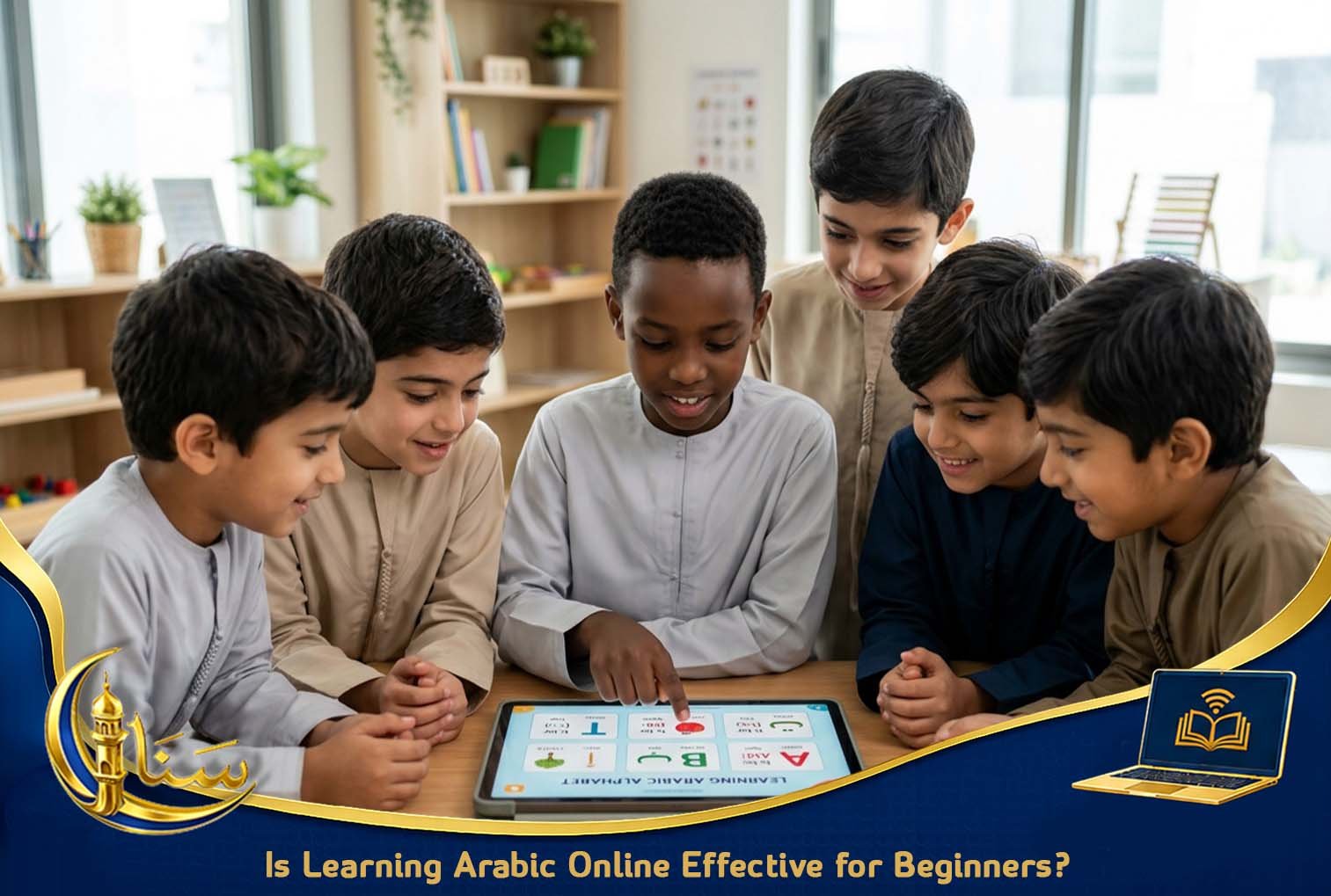
Is Learning Arabic Online Effective for someone who has never studied Arabic before? Yes, online learning can work very well for beginners when lessons follow a clear progression.
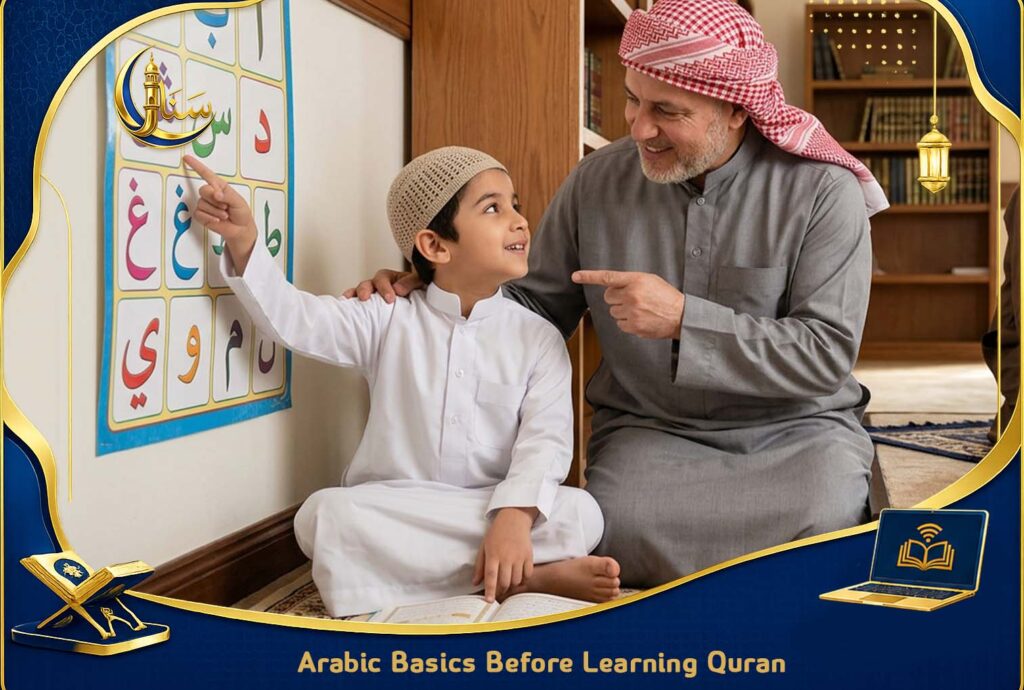
A new learner does not need to begin with complicated grammar or long vocabulary lists. Instead, a strong beginner course should introduce the language gradually. Students can start with the Arabic alphabet, letter sounds, pronunciation, basic vocabulary, and simple expressions.
As their confidence improves, they can move toward sentence formation, reading practice, listening exercises, and basic conversations. Therefore, beginners should look for a course that builds one skill on another rather than presenting unrelated lessons.
An effective online class may include:
- Arabic letters and their correct sounds
- Basic pronunciation practice
- Everyday vocabulary
- Simple Arabic sentences
- Reading short words and phrases
- Listening exercises
- Basic grammar
- Guided speaking practice
- Regular review and correction
Most importantly, beginners should receive immediate feedback. When a teacher corrects pronunciation or explains why a sentence is structured in a particular way, the student can avoid developing incorrect habits.
Start Your Quran Learning Journey Today with Sana Online Quran Academy
Start your Quran learning journey today with Sana Online Quran Academy, where structured and simple programs are designed for both children and adults. In fact, lessons are delivered step by step by qualified teachers who focus on reading skills, basic Tajweed, and gradual improvement with clear explanations.
In addition, you can study from home with flexible schedules that fit your daily routine. Moreover, regular practice and feedback help you improve steadily. As a result, learning becomes easier, more consistent, and more effective.

How Does Online Arabic Learning Work?
One reason Is Learning Arabic Online Effective has become an important search question is that students want to understand how virtual lessons actually operate.
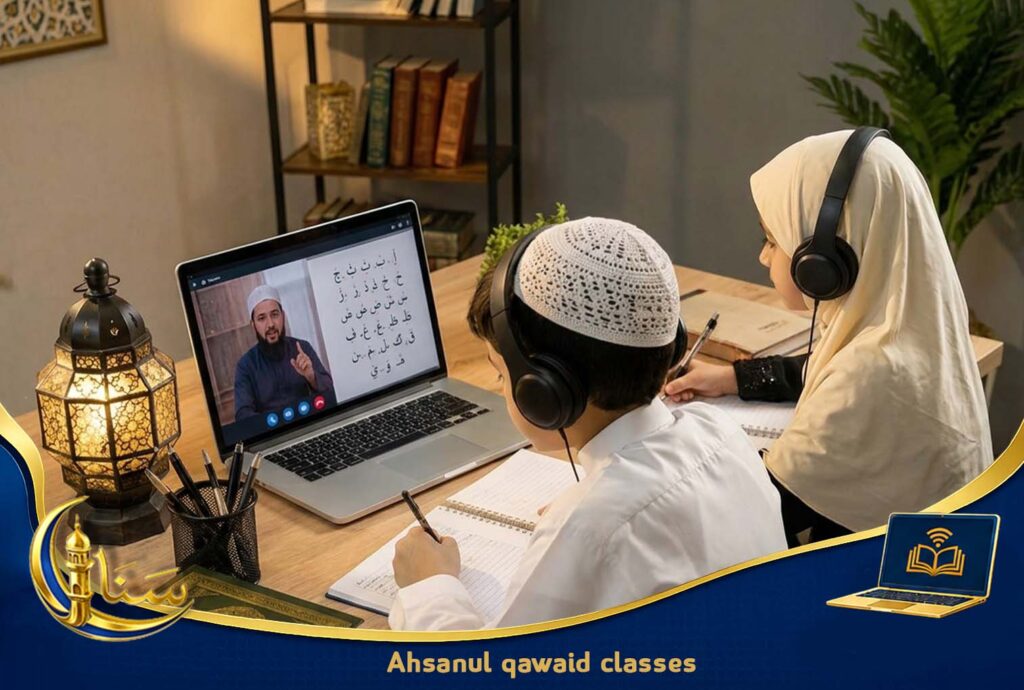
Generally, online Arabic learning combines live instruction, digital learning materials, teacher feedback, and independent practice. Depending on the program, students may attend private lessons or small-group classes through an online platform.
A typical lesson can follow a simple structure:
- The teacher reviews previous material.
- New vocabulary or grammar is introduced.
- The student practices the new concept.
- The teacher identifies mistakes.
- The learner applies the material through speaking, reading, or writing.
- The lesson ends with a review or practice assignment.
This structure gives students a clear learning path. Furthermore, online lessons can be adjusted according to individual performance. A learner who struggles with pronunciation, for example, may need additional speaking practice before moving forward.
With Sana Online Quran Academy, students can benefit from the convenience of learning remotely while receiving guidance from an instructor. The key is to remain consistent and actively participate in every lesson.
Is Learning Arabic Online Effective for Speaking Skills?
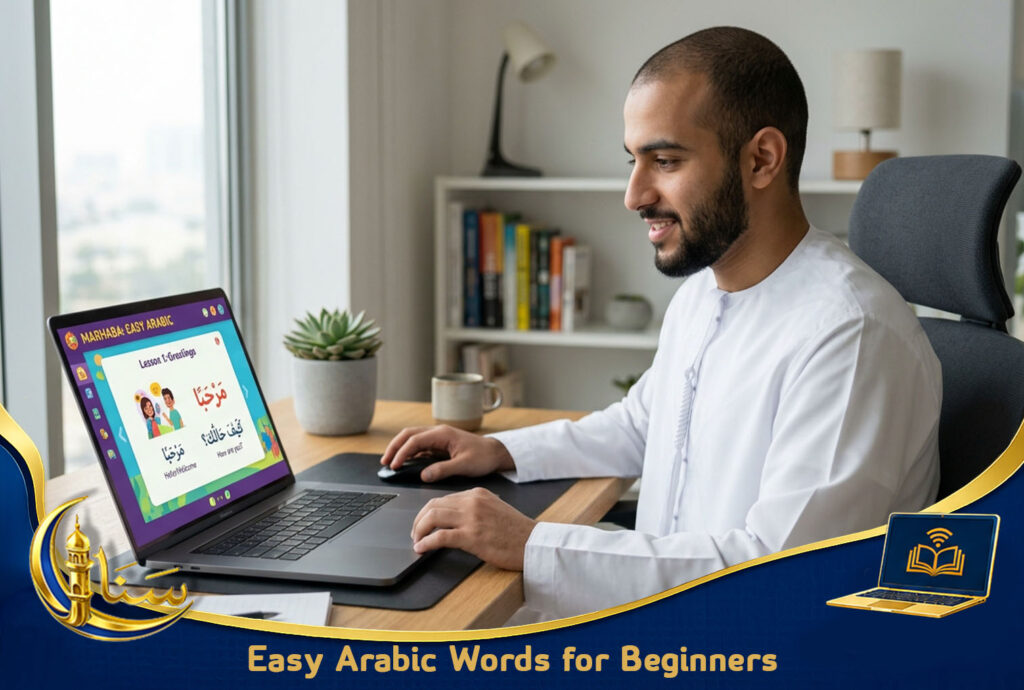
Speaking is one of the areas where online learning can be especially useful. Instead of studying vocabulary without context, students can practice using Arabic during live conversations.
Is Learning Arabic Online Effective for Developing Real Communication Skills? It can be, particularly when the course gives students frequent opportunities to speak.
A teacher can ask questions, introduce everyday situations, and encourage the learner to respond in Arabic. For example, a student might practice introducing themselves, describing their daily routine, asking for directions, ordering food, or discussing familiar subjects.
Regular conversation also helps students become more comfortable making mistakes. Although errors are a normal part of language learning, avoiding conversation can slow progress.
A productive speaking lesson should encourage learners to:
- Answer questions without immediately translating every word.
- Use recently learned vocabulary in complete sentences.
- Practice common expressions.
- Repeat difficult sounds.
- Participate in short conversations.
- Receive corrections without interrupting communication too frequently.
Over time, this approach can help learners move from understanding Arabic to actually using it.
What Skills Can You Develop Through Online Arabic Classes?
A well-designed course should not focus on vocabulary alone. Instead, Arabic learning involves several interconnected skills.
Students may work on:
Reading
Reading practice helps learners recognize Arabic letters, understand word patterns, and gradually process sentences more naturally. Beginners can start with short words before progressing to paragraphs and longer texts.
Writing
Writing reinforces vocabulary and grammar. Students can begin by copying letters and words, then move toward sentences, short descriptions, and independent writing.
Listening
Listening allows learners to become familiar with Arabic pronunciation, rhythm, and natural speech. Therefore, students should hear Arabic regularly rather than relying entirely on written material.
Speaking
Speaking transforms passive knowledge into active communication. Live lessons provide opportunities to answer questions, practice pronunciation, and develop conversational confidence.
Grammar
Arabic grammar can appear difficult at first. However, a teacher can simplify grammatical concepts by explaining them through examples and practical sentences instead of presenting rules in isolation.
For this reason, Sana Online Quran Academy can be considered by learners who want a structured environment where Arabic-related learning takes place online.
Is Learning Arabic Online Effective Without Attending a Physical Classroom?
Is Learning Arabic Online Effective if a student never attends a traditional language institute? For many learners, yes.
Online education removes the need to travel to a classroom. Consequently, students can save commuting time and use that time for actual study or practice.
This advantage can be particularly useful for people with busy schedules. A parent, university student, employee, or frequent traveler may find it easier to attend a scheduled online lesson than travel to a language center several times a week.
There is also greater flexibility in the learning environment. Students can choose a quiet place at home and prepare their materials before the lesson begins.
Nevertheless, convenience alone does not guarantee success. Students still need discipline. They should attend lessons regularly, complete assignments, review new vocabulary, and practice Arabic between sessions.
The strongest results usually come from combining teacher-led lessons with independent practice.
How Do Online Arabic Teachers Make Learning More Effective?
Teacher quality has a major influence on the answer to Is Learning Arabic Online Effective.
A good online instructor does more than explain information. The teacher observes how the student learns, identifies weaknesses, adjusts explanations, and provides useful feedback.
For example, two students may make completely different pronunciation mistakes. One learner may confuse similar Arabic sounds, while another may struggle with reading vowel patterns. A personalized teacher can recognize these differences and modify the lesson accordingly.
Effective teachers can also:
- Correct pronunciation clearly.
- Explain grammar using practical examples.
- Encourage students to speak.
- Identify recurring mistakes.
- Adjust lesson difficulty.
- Review difficult topics.
- Recommend useful practice.
- Track student progress.
Furthermore, personalized feedback can prevent small mistakes from becoming long-term habits.
At Sana Online Quran Academy, students looking for online instruction should still consider whether the available teaching approach matches their goals, level, schedule, and preferred learning style.
Is Learning Arabic Online Effective for Quranic Arabic?
Some students study Arabic because they want to understand the Quran more deeply. In that case, their needs may differ from someone learning Arabic primarily for travel or everyday conversation.
Is Learning Arabic Online Effective for Quranic Arabic? It can be, provided the course focuses on the specific language skills required for understanding Quranic texts.
Quranic Arabic may involve vocabulary, grammar, sentence structures, and expressions that differ from the language used in modern daily conversations. Therefore, students should identify this goal before enrolling.
A suitable learning path may include:
- Frequently occurring Quranic vocabulary
- Arabic grammar fundamentals
- Word meanings in context
- Sentence analysis
- Reading practice
- Understanding common structures
- Vocabulary review
- Guided interpretation of language patterns
Students should also understand that learning Arabic and studying Quranic interpretation are related but distinct goals. A language course can improve the ability to recognize and understand Arabic, while deeper interpretation may require additional Islamic studies.
What Makes Online Arabic Learning Different From Self-Study?
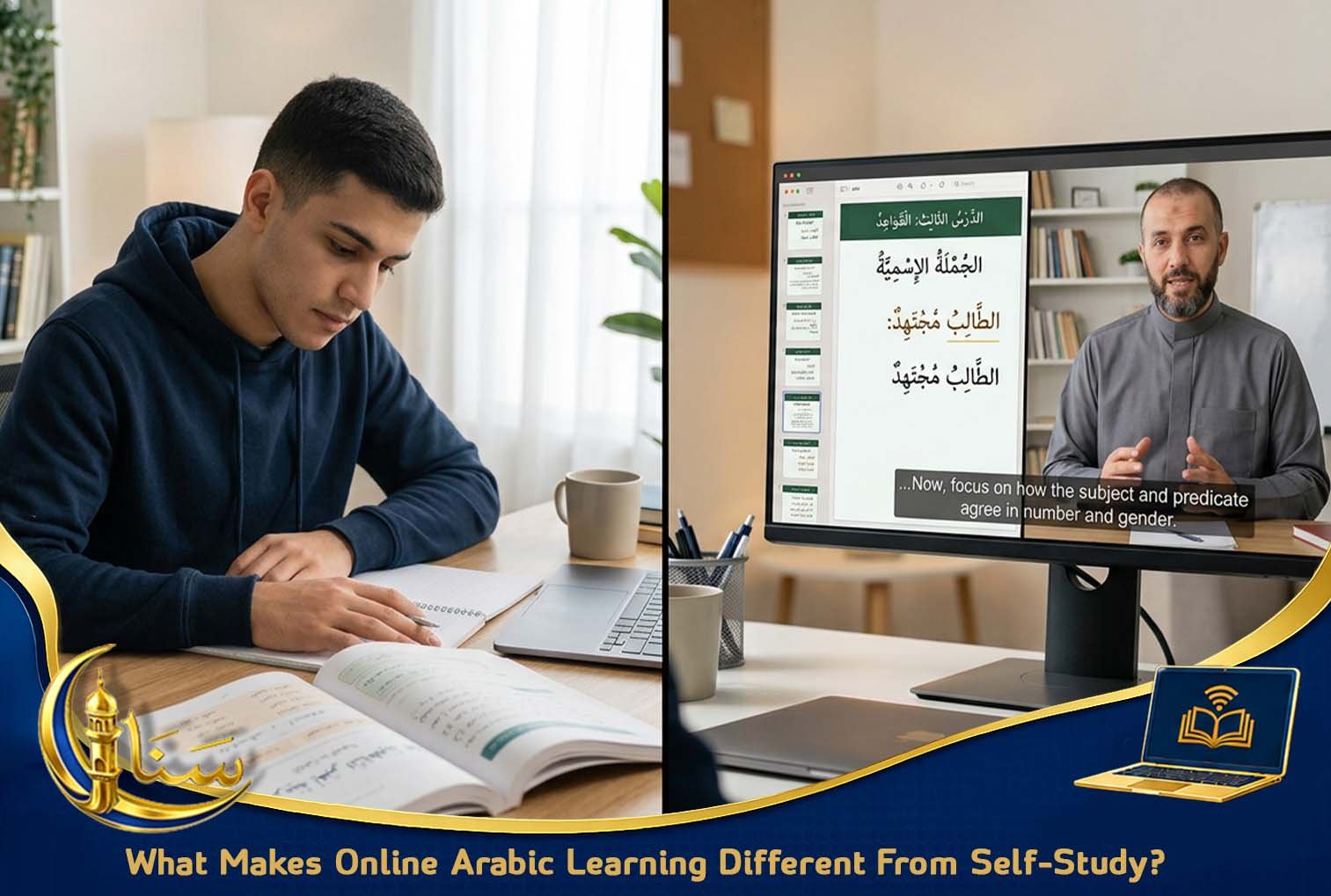
Self-study resources can be useful, but they often leave students responsible for identifying and correcting their own mistakes.
That difference helps explain why learning Arabic online is effective for learners who have struggled to make progress independently.
With a teacher, students can ask questions immediately. They can also receive explanations tailored to their level instead of searching through multiple resources for answers.
For instance, a learner might memorize a word but pronounce it incorrectly. A textbook may not identify the problem, whereas a live instructor can hear the pronunciation and correct it immediately.
Online instruction can therefore combine the independence of digital education with the accountability of teacher-guided learning.
Still, independent study remains valuable. Students can reinforce lessons by reading, listening to Arabic audio, reviewing vocabulary, and practicing conversations between classes.
The most effective approach is often a combination of both methods rather than choosing one exclusively.
Is Learning Arabic Online Effective With a Busy Schedule?
Time is one of the biggest challenges for adult learners. Fortunately, online lessons can make Arabic study easier to fit into a demanding routine.
Is Learning Arabic Online Effective for people who have only a few hours available each week? Yes, as long as expectations are realistic.
Students do not necessarily need several hours of daily instruction. Consistent sessions combined with short practice periods can produce meaningful progress over time.
For example, a learner might:
- Attend two live lessons each week.
- Review vocabulary for 15 minutes daily.
- Practice listening during a commute.
- Read a short Arabic passage several times a week.
- Use new vocabulary in simple sentences.
Consistency matters more than studying intensively for a few days and then stopping for several weeks.
Moreover, online scheduling can reduce wasted travel time. That makes it easier for learners to maintain a routine.
How Much Practice Do You Need Outside Online Arabic Classes?
Lessons alone are rarely enough to create strong language skills. Students need opportunities to use what they learn.
Therefore, when asking Is Learning Arabic Online Effective, it is important to consider what happens between lessons.
A simple practice routine could include several short activities rather than one long study session. For example, learners can review five to ten vocabulary words, listen to Arabic audio, read a short passage, or practice speaking aloud.
Short and frequent practice has another advantage: it keeps Arabic active in the learner’s memory.
Students should focus on meaningful repetition. Instead of memorizing a word once, they can use it in several sentences and situations.
For example, after learning a new verb, a student might practice its meaning in the past, present, and future context. This makes the vocabulary more useful and easier to recall.
What Factors Affect the Cost of Online Arabic Classes?
The cost of online Arabic education can vary significantly. Consequently, students should avoid judging a course only by its monthly price.
Several factors may influence the total cost:
- Teacher experience
- Private or group instruction
- Lesson duration
- Number of classes per week
- Student’s language level
- Course specialization
- Learning materials
- Platform or service structure
- Additional support
A private course may cost more than group instruction because the teacher can dedicate the lesson to one learner. However, personalized attention can also make the learning process more focused.
Similarly, a student who takes several lessons each week may pay more per month but receive more practice and teacher interaction.
When comparing programs, students should calculate the value of the entire learning package rather than looking at a single price.
Is Learning Arabic Online Effective for Children?
Parents often wonder whether online Arabic education can keep children engaged.
Is Learning Arabic Online Effective for Children? It can work well when lessons are designed around the child’s age, attention span, and learning ability.
Children usually respond better to interactive activities than long explanations. Therefore, online teachers should use age-appropriate exercises, repetition, visual materials, simple conversations, and encouraging feedback.
Parents can also support learning by creating a consistent study environment.
Helpful habits include:
- Keeping lesson times consistent.
- Providing a quiet learning space.
- Reducing distractions.
- Encouraging children to participate.
- Reviewing simple vocabulary after class.
- Celebrating progress rather than focusing only on mistakes.
Children do not need to master large amounts of material during every lesson. Instead, steady progress and positive experiences can help build long-term motivation.
How Should You Choose an Online Arabic Course?
Choosing the right program is more important than simply choosing the most convenient option.
Before deciding whether learning Arabic online is effective for you, evaluate the course itself. Ask whether it provides the type of instruction you actually need.
Consider these questions:
Does the Course Match Your Goal?
Someone learning Arabic for conversation needs a different approach from someone studying Arabic to understand Quranic texts.
Is the Teacher Qualified?
Look for an instructor who can explain Arabic clearly, correct mistakes, and communicate effectively with students.
Are Lessons Personalized?
Individual attention can be particularly helpful when students have different strengths and weaknesses.
Is the Schedule Practical?
A course is only useful if you can attend consistently. Therefore, choose lesson times that realistically fit your routine.
Is There Regular Feedback?
Students need to know what they are doing well and what needs improvement.
Does the Course Encourage Active Practice?
Speaking, reading, listening, and writing should form part of the learning experience rather than relying entirely on passive study.
These questions can help learners make a more informed decision.
Is Learning Arabic Online Effective With One-to-One Lessons?
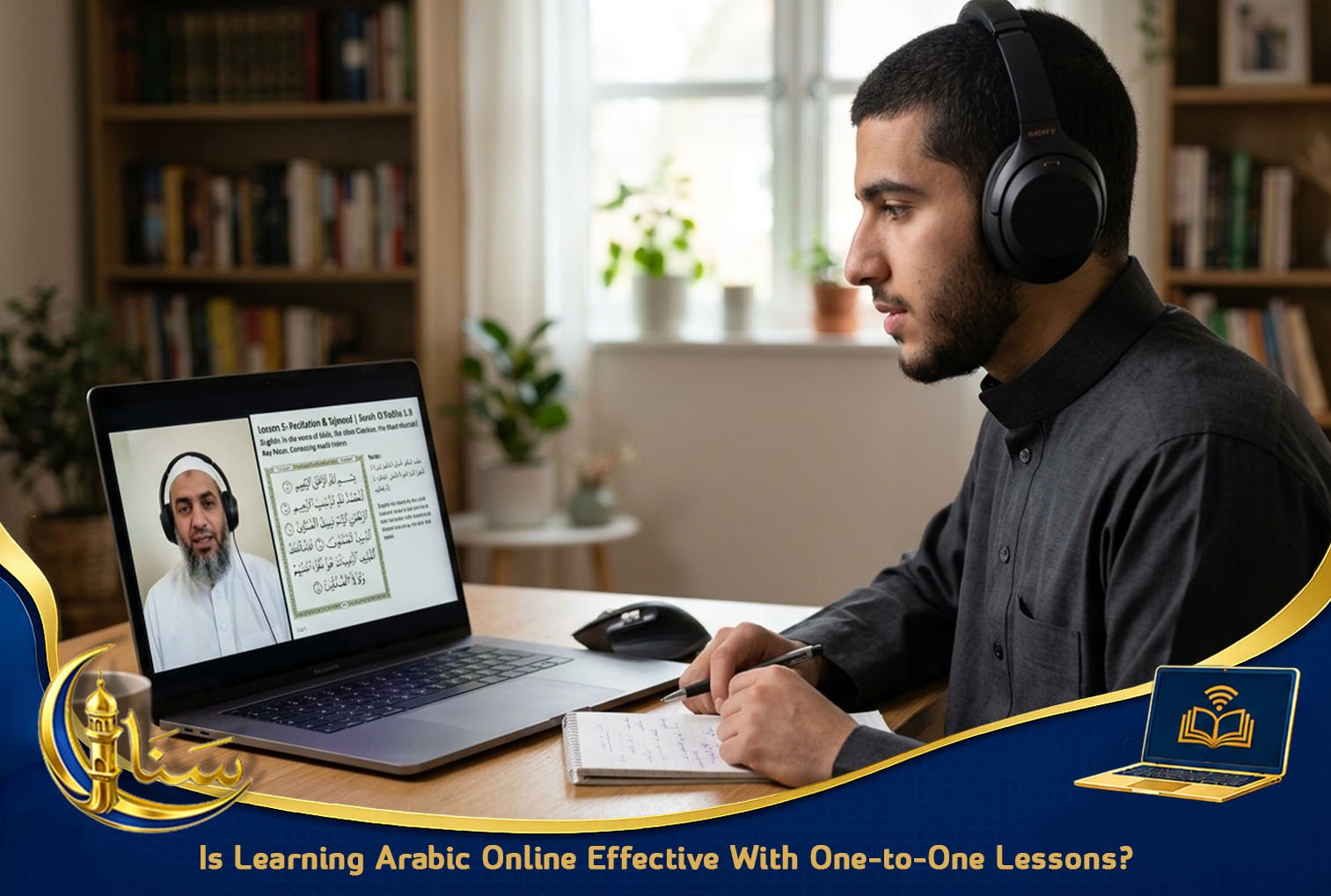
One-to-one instruction can provide a highly personalized learning experience. During a private lesson, the teacher can focus entirely on the student’s current level, goals, and areas that require additional attention.
So, Is Learning Arabic Online Effective when private lessons are used? In many cases, yes, particularly for learners who benefit from individualized guidance. A private student can spend extra time working on pronunciation, grammar, vocabulary, or conversation instead of following a fixed pace designed for a larger group.
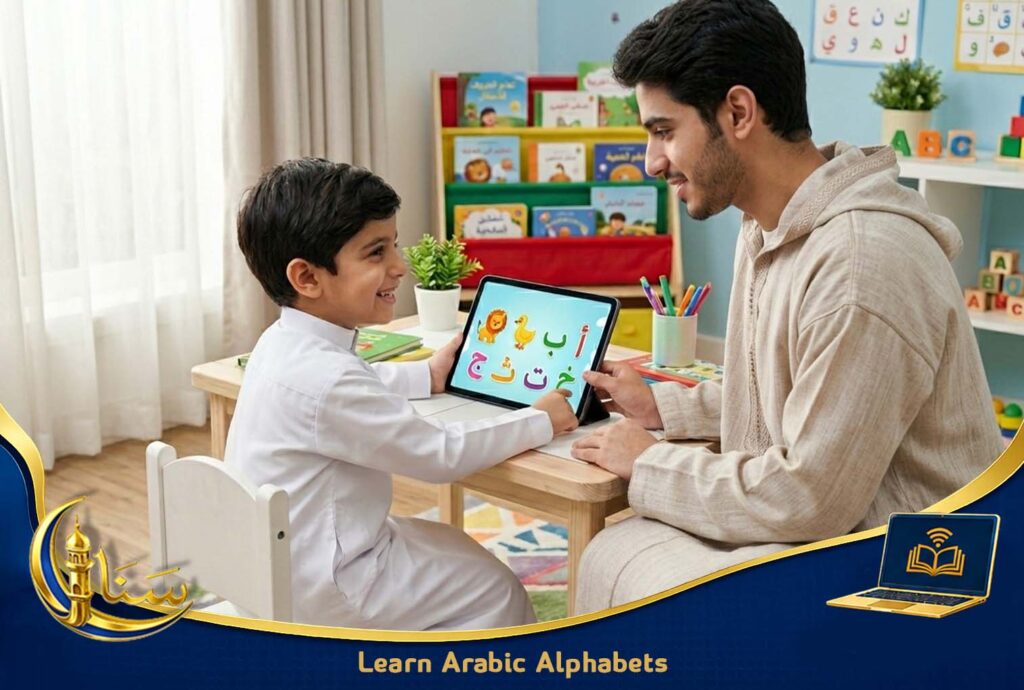
For example, a beginner struggling with the Arabic Alphabet for Beginners may need additional pronunciation practice before moving to complete words. Meanwhile, an intermediate learner might benefit more from conversation exercises and sentence construction.
Private lessons also allow the teacher to adjust the pace. Students who understand a topic quickly can move forward, while those who need more explanation can review the concept without feeling pressured.
However, personalized instruction works best when the student participates actively. Asking questions, speaking during lessons, completing exercises, and reviewing new material can significantly strengthen the learning process.
How Can Sana Online Quran Academy Support Arabic Learners?
Sana Online Quran Academy can be an option for students who prefer remote learning and teacher-guided instruction. An online academy can make language education more accessible because students can attend lessons without traveling to a physical classroom.
The value of an online program, however, depends on the quality of its teaching approach. Learners should look for organized lessons, clear communication, suitable scheduling, opportunities for interaction, and measurable progress.
For prospective students, useful factors to consider include:
- Current Arabic proficiency
- Main reason for learning Arabic
- Available lesson times
- Individual or group class preferences
- Teacher-student interaction
- Lesson frequency
- Opportunities for independent practice
- Methods used to monitor progress
Students should also explain their goals before starting. Someone interested in conversational Arabic may need a different curriculum from a learner who wants to understand Quranic vocabulary.
Those comparing programs may also find it useful to review Why Many Families Prefer Female Quran Tutors when considering which teaching environment best suits their family.
Ultimately, Sana Online Quran Academy may suit learners who value flexibility, structured instruction, and regular teacher support.
Common Mistakes That Can Reduce Online Arabic Progress
Even an effective course can produce limited results when students develop unhelpful study habits. One common problem is attending lessons without reviewing the material afterward. Arabic requires repetition, so new vocabulary and grammar need regular reinforcement.
Another issue is concentrating entirely on memorization. Learning vocabulary is useful; however, students also need to understand how words function within sentences and real conversations.
Fear of mistakes can create another obstacle. Some learners understand a considerable amount of Arabic but hesitate to speak because they worry about pronunciation or grammar errors. In reality, making manageable mistakes can help reveal areas that require more practice.
Other common problems include:
- Skipping lessons frequently
- Changing learning methods too often
- Memorizing isolated vocabulary
- Neglecting pronunciation practice
- Studying grammar without practical examples
- Avoiding listening activities
- Expecting fluency within a short period
- Failing to review previous lessons
Learners should therefore establish realistic expectations from the beginning. Additionally, anyone experiencing Common Problems in Online Quran Classes can apply similar principles when evaluating communication, scheduling, technology, and student participation in an online learning environment.
Is Learning Arabic Online Effective in the Long Term?
Long-term success depends less on the technology itself and more on how consistently the learner uses the available resources.
Is Learning Arabic Online Effective over several months or years? Yes, online education can support meaningful language development when instruction is consistent and students actively practice between lessons.
Language acquisition happens gradually. A beginner may first recognize letters, then read simple words, understand common expressions, construct basic sentences, and eventually participate in longer conversations.
Progress may not be obvious after every individual lesson. Nevertheless, the difference can become much clearer when learners compare their abilities after several months of consistent study.
For that reason, it is helpful to track practical milestones rather than simply asking whether you are fluent yet. A learner might measure progress by asking:
- Can I introduce myself in Arabic?
- Can I understand common questions?
- Can I read a short passage?
- Can I recognize familiar vocabulary?
- Can I create basic sentences?
- Can I follow a simple conversation?
These measurable goals provide a clearer picture of development and can help maintain motivation.
How to Get Better Results From Online Arabic Lessons
A well-designed course becomes considerably more useful when students participate actively. Before each lesson, review previous material so that new information has a foundation. During class, ask questions, practice speaking, and request clarification whenever something is unclear.
Afterward, spend a short period reviewing what you learned. This simple habit can strengthen memory and reduce the amount of material you need to relearn later.
A practical routine might include:
- Before class: Review previous vocabulary and notes.
- During class: Participate actively and ask questions.
- After class: Record important corrections.
- Later that day: Practice new words and sentences.
- During the week: Listen to Arabic and read simple content.
- Before the next class: Review the previous lesson again.
Furthermore, keep a record of recurring mistakes. If the same pronunciation or grammar problem appears repeatedly, dedicate additional practice time to it instead of simply moving forward.
Students who are also learning Quranic Arabic can explore Learn Quran Online With Female Teachers if teacher preference and Quran-focused instruction are important considerations.
Finally, learners who are comparing different programs can benefit from understanding How to Choose the Best Online Arabic Academy before committing to a long-term course. Evaluating curriculum quality, teacher experience, lesson structure, communication, and student support can make the decision more informed.
Is Learning Arabic Online Effective vs. Traditional Classes?

Both online and face-to-face learning can be effective. The better option depends on the student’s circumstances and learning preferences.
Online learning offers flexibility, remote access, and convenient scheduling. Traditional classes may provide a physical classroom environment and direct interaction with other students.
Is Learning Arabic Online Effective compared with attending a physical institute? It can certainly be competitive when the online program provides qualified teachers, structured lessons, personalized feedback, and regular practice.
For many learners, the biggest advantage is convenience. Removing travel can make regular attendance easier, which is important because consistency strongly influences language development.
Therefore, the decision should not be based solely on whether classes are online or offline. Instead, compare the quality of teaching, course structure, learning goals, schedule, support, and practice opportunities.
Frequently Asked Questions About Is Learning Arabic Online Effective
Address common concerns about online Arabic learning, including its benefits, challenges, and long-term results.
1. How quickly can someone understand basic Arabic conversations online?
The timeline varies from one learner to another. However, students who practice listening and speaking consistently may begin recognizing common expressions and familiar conversational patterns before they become fluent. The amount of weekly exposure, previous language experience, and consistency all influence this process.
2. Can I learn Arabic online if I cannot read Arabic letters yet?
Yes. Many Arabic programs can begin with the alphabet and pronunciation. Starting with letters, sounds, and simple combinations allows complete beginners to establish the foundation needed for later reading and language study.
3. Should I learn Modern Standard Arabic or a specific Arabic dialect?
That depends on your purpose. Modern Standard Arabic is useful for formal communication, written material, news, and many educational contexts. A dialect may be more appropriate if your primary goal is everyday conversation with people from a particular region.
4. Can online Arabic lessons help someone who has studied Arabic before but forgotten most of it?
Yes. A teacher can first assess the learner’s current ability and identify which skills remain strong and which need review. This can prevent the student from repeating everything from the beginning and allow the course to focus on forgotten vocabulary, grammar, pronunciation, or communication skills.
In conclusion, so, Is Learning Arabic Online Effective? Yes, it can be an effective and practical way to learn Arabic when the student chooses an appropriate program and follows a consistent study routine.
Online education offers several advantages, including flexible scheduling, remote access, personalized instruction, and direct communication with teachers. Moreover, students can combine live lessons with independent reading, listening, vocabulary review, and speaking practice.
However, technology alone does not create language proficiency. The quality of instruction, students’ commitment, lesson consistency, and amount of practice all matter.
For learners considering Sana Online Quran Academy, the most important step is to identify their goals first and then determine whether the available learning approach matches those goals.
Ultimately, Is Learning Arabic Online Effective is not simply a question about the internet or virtual classrooms. It is a question about whether the learning experience gives students the right teacher, structure, practice, feedback, and motivation to continue improving.
When those elements come together, online Arabic learning can become a flexible and rewarding path toward stronger reading, listening, speaking, writing, and language comprehension skills.