
Common Problems in Online Quran Classes can affect the quality of learning when students, parents, or teachers do not have the right structure, communication, and learning environment. Online Quran education has made it possible for children and adults to study Quran recitation, Tajweed, memorization, and Islamic knowledge from home.
However, convenience alone does not guarantee effective learning. Students may face technical interruptions, weak concentration, pronunciation difficulties, inconsistent attendance, limited interaction, or challenges in understanding Arabic.
The good news is that most of these difficulties can be managed with a thoughtful learning plan. A suitable teacher, reliable technology, regular practice, parental support, and realistic goals can turn an online class into a productive and engaging learning experience. Therefore, understanding the challenges before they become serious obstacles is an important step for every learner.
This guide explains the major difficulties students may encounter during online Quran lessons. It also explores practical solutions that can help parents and students create a more focused, comfortable, and successful learning routine.
Why Do Common Problems Occur in Online Quran Classes?

Online Quran learning is different from studying in a traditional classroom or mosque. The teacher and student are not physically present in the same room, so several parts of the learning process depend on technology, communication, and self-discipline.
For example, a student who studies from home may have access to a comfortable environment, but the same environment can contain many distractions. A child may hear family conversations, receive notifications, play with nearby objects, or leave the lesson whenever attention decreases. Similarly, an adult learner may struggle to attend consistently because of work, family responsibilities, or changing schedules.
Another factor is the difference between students. A beginner who is still learning Arabic letters needs a different approach from an advanced student studying detailed Tajweed rules. Age, previous knowledge, language, personality, and learning speed all influence the effectiveness of an online lesson.
Consequently, successful online Quran education requires more than simply connecting to a video call. It requires a system that considers the learner’s needs from the beginning.
Start Your Quran Learning Journey Today with Sana Online Quran Academy
Start your Quran learning journey today with Sana Online Quran Academy, where structured and simple programs are designed for both children and adults. In fact, lessons are delivered step by step by qualified teachers who focus on reading skills, basic Tajweed, and gradual improvement with clear explanations.
In addition, you can study from home with flexible schedules that fit your daily routine. Moreover, regular practice and feedback help you improve steadily. As a result, learning becomes easier, more consistent, and more effective.

Common Problems in Online Quran Classes: Technical Difficulties
Technical problems are among the most noticeable challenges in online Quran education. A lesson can be well prepared, yet a weak internet connection may interrupt communication and reduce the student’s ability to hear the teacher clearly.
Audio quality is particularly important when learning Quran recitation. Students need to hear the exact pronunciation of letters, vowels, elongations, stops, and other details. If the sound repeatedly cuts out, the learner may misunderstand a correction or repeat an error without realizing it.
Video problems can also affect the lesson. When the teacher cannot clearly see the student’s mouth or facial position, correcting certain pronunciation issues may become more difficult. This is especially relevant for beginners who need close observation while practicing Arabic letters.
However, technical difficulties do not always require complicated solutions. Families can prepare for lessons by checking the internet connection, testing the microphone, keeping the device charged, and choosing a quiet location with stable connectivity.
It is also helpful to have a backup plan. If the main device stops working, another phone or computer can sometimes prevent the entire lesson from being lost.
How to Reduce Technical Problems During Quran Lessons?
A few simple habits can make online learning much more reliable:
- Test the microphone before the lesson.
- Keep the device connected to a charger when possible.
- Use headphones if background noise is a problem.
- Close unnecessary applications and browser tabs.
- Place the camera where the teacher can clearly see the student.
- Keep login information and class links accessible.
- Inform the teacher quickly when a technical issue occurs.
These steps may appear simple, but they can save valuable learning time. More importantly, they allow the student to concentrate on Quran study instead of constantly trying to solve technical problems.
Common Problems in Online Quran Classes: Lack of Concentration
Concentration is another major challenge, particularly for young learners. A home environment does not automatically create a classroom atmosphere. Children may feel that they are free to move around, use another device, talk to siblings, or look away from the screen. For younger students, structured Quran Classes for Kids at Home can help create a more focused routine by giving the lesson a clear time and dedicated learning space.
Long lessons can make the situation worse. If the teaching style does not match the child’s age and attention span, the learner may gradually lose interest even when the teacher is knowledgeable.
Adults can face a different form of distraction. Work notifications, household responsibilities, phones, and unfinished tasks may occupy the mind during the lesson.
Therefore, creating a dedicated learning environment is essential. The student should have a specific place for Quran lessons whenever possible. The area does not need to be large or elaborate. It simply needs to be quiet, organized, and associated with study time.
Parents can also remove unnecessary distractions before the class begins. Turning off notifications, putting unrelated devices away, and informing family members that the student is attending a lesson can make a noticeable difference.
Making Online Quran Classes More Engaging
Engagement improves when the student is actively involved rather than listening passively for the entire lesson. Teachers can ask the learner to recite, repeat examples, identify mistakes, explain a rule, or answer short questions.
For children, variety can be particularly effective. A teacher may divide the lesson into smaller activities instead of presenting one long explanation. Recitation, repetition, correction, review, and short questions can create a more dynamic session.
At the same time, engagement should not mean turning every lesson into entertainment. Quran education requires seriousness and respect. The goal is to make learning accessible and interactive while maintaining the proper character of Quran study.
Pronunciation and Tajweed Difficulties
Correct pronunciation is one of the most important aspects of learning the Quran. Arabic contains sounds that may not exist in the student’s native language. Consequently, learners can struggle with letters such as ع, ح, خ, ص, ض, ط, ظ, and ق. Reviewing Common Tajweed Mistakes Beginners Make can help students and parents recognize pronunciation problems and address them before they become established habits.
A student may understand a Tajweed explanation intellectually but still have difficulty applying it during recitation. This happens because pronunciation depends on repeated practice and careful listening, not memorization of definitions alone.
For beginners, the challenge can start even earlier. Some learners may confuse letters with similar shapes or sounds. Others may read slowly because they have not yet developed confidence with Arabic words.
The solution is patience and systematic correction. Students should not be expected to master pronunciation after one explanation. Instead, the teacher should identify recurring errors, demonstrate the correct sound, allow the learner to repeat it, and revisit it regularly.
How Can Teachers Solve Tajweed Problems Online?
Effective online Tajweed teaching requires close listening. The teacher should allow enough time for the student to recite independently rather than speaking most of the lesson. Students who wonder How Long Does It Take to learn Tajweed should understand that the timeline varies according to their starting level, practice frequency, pronunciation difficulties, and ability to apply the rules consistently.
Corrections should also be specific. Instead of simply saying that a word is incorrect, the teacher can identify the letter, explain the relevant rule, demonstrate the sound, and ask the student to repeat it.
Recording practice can also help when used appropriately. A learner may record a short recitation and listen again to identify areas that require additional practice. However, recordings should support teacher feedback rather than replace it.
Progress should be measured realistically. Pronunciation develops gradually, particularly for students whose first language is not Arabic.
Memorization Challenges in Online Quran Classes
Memorizing Quran requires consistency. A student may memorize several pages quickly but struggle to retain them if revision is neglected. Using Best Quran Memorization Techniques can help learners organize new memorization, regular revision, repetition, and progress tracking more sustainably.
One of the common mistakes is focusing exclusively on new memorization. Students sometimes become excited about completing additional verses and give insufficient attention to previously learned material. As a result, earlier portions become weaker over time.
A balanced routine should include both new memorization and revision. The exact amount depends on the student’s age, ability, schedule, and goals.
For children, small and achievable targets are often more effective than demanding large portions. Success with a manageable target can build confidence and encourage continued effort.
Adults may prefer flexible plans that fit around work and family responsibilities. What matters most is not memorizing an impressive amount in one session but maintaining a sustainable routine.
Choosing the Right Quran Teacher
The teacher’s communication style can also influence the student’s experience. Some families may prefer a teaching approach that feels comfortable and supportive, especially when children require patience and close guidance. This is one reason families may explore Why Many Families Prefer Female Quran Tutors when choosing an instructor for children or other learners who feel more comfortable with a female teacher.
Building a Strong Quran Memorization Routine
A useful memorization routine can include four stages:
- Listening: Hear the selected verses carefully from a reliable reciter.
- Reading: Read the verses several times while looking at the Mushaf.
- Reciting from memory: Close the Mushaf and attempt the passage independently.
- Revision: Return to previously memorized portions regularly.
The final stage is especially important. Revision protects earlier memorization and helps connect different sections of the Quran.
Students should also understand the meaning of what they memorize whenever appropriate. Understanding the general meaning can help learners recognize the sequence of ideas and remember verses more naturally.
Language Barriers in Online Quran Learning
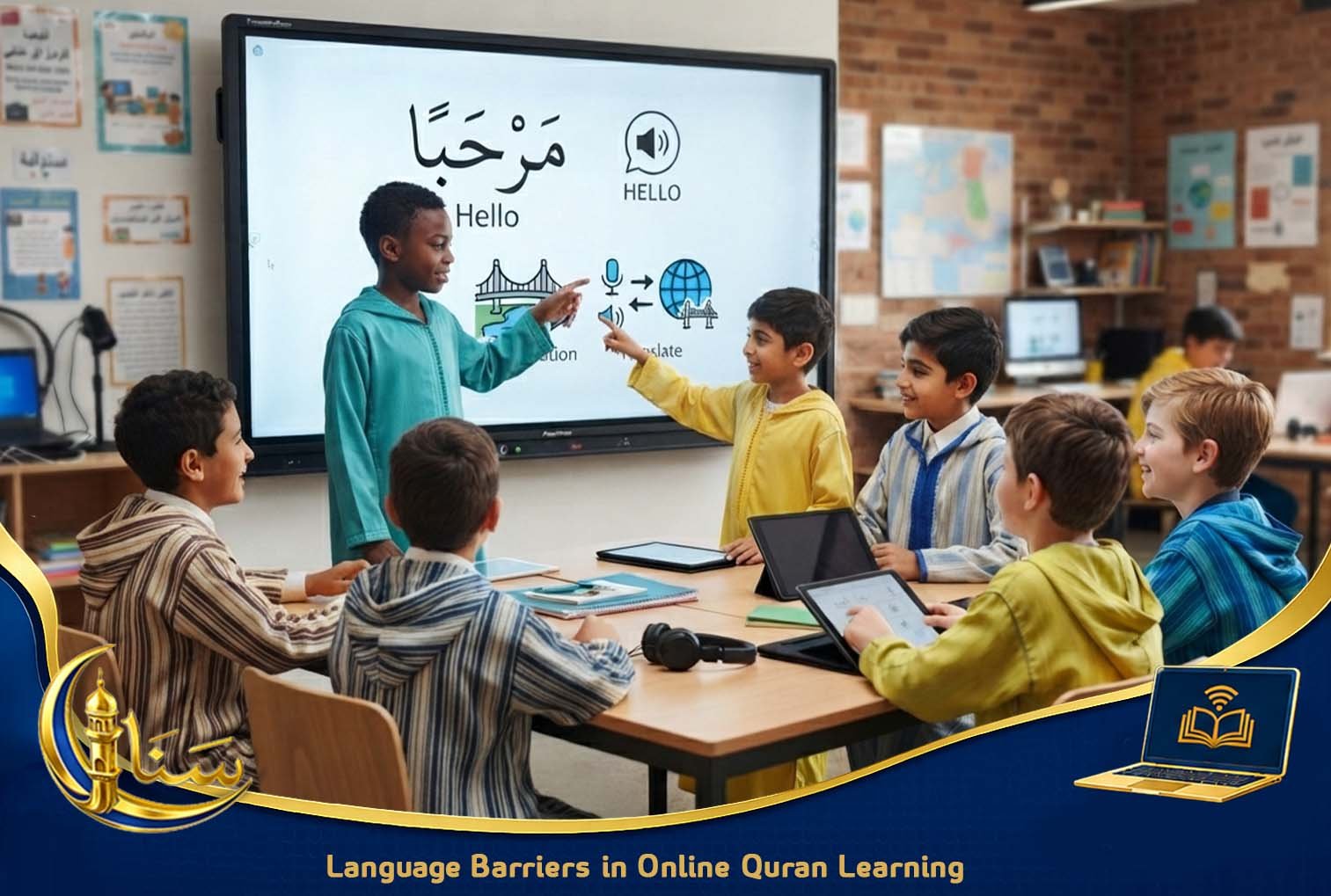
Language differences can create difficulties between teachers and students. A learner may understand Quranic Arabic at a basic level but struggle with technical Tajweed terminology or detailed explanations.
This issue is particularly common among children growing up in non-Arabic-speaking environments. They may know how to speak their family’s language but have limited Arabic vocabulary.
A teacher who understands this challenge can adapt explanations without compromising the accuracy of Quranic instruction. Simple language, demonstrations, repetition, and examples can make difficult concepts easier to understand.
Parents should also communicate with the teacher about the child’s language level. This information helps the teacher choose suitable explanations and avoid unnecessary confusion.
Common Problems in Online Quran Classes: Inconsistent Attendance
Consistency strongly influences Quran learning. Missing an occasional lesson is understandable, but frequent interruptions can make progress difficult.
When students repeatedly miss classes, they may forget previous material, lose momentum, and require additional time to review. Children can also develop the habit of treating lessons as optional.
A fixed weekly schedule can help. Families should select realistic lesson times rather than choosing a schedule that looks ideal but is difficult to maintain.
The same principle applies to adults. A learner with a busy schedule may benefit from fewer lessons that can be attended consistently rather than a demanding schedule that creates repeated cancellations.
Creating a Sustainable Quran Study Schedule
A good schedule should answer several practical questions:
- When is the student most alert?
- How many lessons can the family realistically maintain?
- How much daily practice is possible?
- Which days are usually busy?
- How much time is needed for revision?
Once these questions are answered, the family can create a routine that fits real life.
Consistency should be valued more than intensity. A manageable routine followed for months can produce better results than an ambitious schedule maintained for only a few weeks.
Limited Interaction Between Teacher and Student
Some students feel that online lessons are less personal than face-to-face learning. This can happen when the teacher speaks for most of the lesson or when the student is not encouraged to participate.
Quran education requires active practice. A student needs opportunities to recite, ask questions, receive corrections, and demonstrate understanding.
Teachers can improve interaction by assigning the learner specific roles during the lesson. For example, the student can begin with revision, explain a Tajweed rule in simple words, recite a new passage, and identify a mistake in a practice example.
Parents can also ask the child about the lesson afterward. Questions such as “What did you learn today?” or “Which rule did you practice?” encourage the learner to reflect on the session.
Common Problems in Online Quran Classes: Choosing the Wrong Teacher
The quality of the teacher can influence the entire learning experience. A teacher may have strong Quranic knowledge but use a teaching style that does not suit a particular learner.
For example, a young child may require more encouragement and shorter activities, while an adult learner may prefer detailed explanations and structured goals.
Therefore, families should consider more than credentials. They should also evaluate communication, patience, lesson organization, pronunciation correction, and the teacher’s ability to adapt.
A suitable teacher should understand that students progress at different speeds. Comparing learners can discourage those who need additional practice.
What Makes an Effective Online Quran Teacher?
An effective teacher generally combines knowledge with teaching ability. Important qualities include:
- Strong Quran recitation and Tajweed knowledge.
- Clear pronunciation.
- Patience with repeated mistakes.
- Good communication skills.
- Ability to adapt lessons to different ages.
- Organized lesson planning.
- Respectful and encouraging behavior.
- Regular feedback about student progress.
The teacher should also create an environment in which students feel comfortable asking questions. A learner who is afraid of making mistakes may remain silent and continue practicing incorrectly.
Parental Support and Home Environment
Parents play an important role, especially when children study Quran online. Their role does not mean sitting beside the child throughout every lesson. Instead, effective support can involve creating the right conditions for learning.
Parents can make sure the child joins on time, has the required materials, and practices between lessons. They can also communicate with the teacher when a problem repeatedly affects progress.
Encouragement is more useful than excessive pressure. If a child makes a mistake, criticism may increase anxiety. Positive feedback can help the learner develop confidence while still understanding the importance of correction.
The home environment also matters. When Quran study becomes part of the family’s routine, children may view learning as a meaningful responsibility rather than an isolated activity.
Common Problems in Online Quran Classes: Lack of Practice

A weekly lesson alone is rarely enough to develop strong recitation. Students need regular practice between classes.
Without practice, the learner may understand a rule during the lesson but forget how to apply it later. Similarly, memorized verses may become weaker without revision.
The best practice routine is usually short and consistent. Even a focused daily session can be more useful than a long practice period once a week.
Students should focus on the specific areas identified by their teacher. If pronunciation is the main weakness, practice should target difficult letters and words. If memorization is the challenge, revision should receive more attention.
How to Measure Progress in Online Quran Learning?
Progress should not be measured only by the number of pages completed. Quran education has several dimensions, including accuracy, fluency, Tajweed, memorization, confidence, and understanding.
A student who learns fewer pages but significantly improves pronunciation may be making excellent progress.
Teachers can provide regular feedback by identifying strengths and areas that require further attention. Parents can keep simple records of completed lessons, memorized portions, and recurring difficulties.
Small improvements should be recognized. A learner who previously struggled with a particular letter but can now pronounce it correctly has achieved meaningful progress.
Common Problems in Online Quran Classes: Motivation and Discipline
Motivation naturally changes. Students may begin with enthusiasm and later experience periods when studying feels difficult.
This is normal. Rather than depending entirely on motivation, learners should develop habits that continue even when enthusiasm decreases.
Clear goals can help. A student may aim to improve a particular Tajweed rule, complete a selected memorization portion, or become more fluent in recitation.
Short-term goals are especially useful because they make progress visible. Once a learner sees improvement, confidence often increases.
Teachers and parents can also remind students of the purpose behind Quran learning. The goal is not simply to complete lessons quickly but to develop a lasting relationship with the Quran through accurate reading, understanding, reflection, and practice.
Creating a Better Online Quran Learning Environment
A productive environment combines physical preparation, digital readiness, and emotional comfort.
The physical space should be quiet and free from unnecessary distractions. The technical setup should provide clear audio and stable communication. Meanwhile, the student should feel respected and encouraged.
A simple pre-class routine can make the transition into learning easier. The student can prepare the Mushaf, notebook, headphones, and water before the teacher joins.
After the class, a few minutes of review can reinforce what was learned. This small habit prevents the lesson from becoming disconnected from the rest of the week.
How Can Sana Online Quran Academy Support Learners?
Choosing a structured learning provider can help families address several challenges associated with online Quran education. Sana Online Quran Academy can be considered by learners who want an organized online environment for Quran study and guidance.
A structured academy can make it easier to establish regular lessons, communicate learning goals, and follow a consistent educational path. Nevertheless, families should always consider whether the available program, teaching approach, schedule, and course level match the individual student’s needs.
For parents, communication is particularly important. They should understand what the student is expected to practice between lessons and how progress will be evaluated.
Students can also benefit from having clear objectives instead of attending classes without a defined direction. Whether the goal is Quran reading, Tajweed improvement, memorization, or another area of Quranic education, the learning plan should reflect that goal.
Common Problems in Online Quran Classes: How to Choose the Right Program?
Selecting an online Quran program should be based on the student’s actual needs. A program that works well for one learner may not be ideal for another.
Before choosing a course, families can consider the following factors:
- Does the program offer lessons appropriate for the student’s level?
- Is the teacher experienced in online instruction?
- Can the schedule fit the family’s routine?
- Does the lesson include enough student participation?
- How are pronunciation and Tajweed mistakes corrected?
- Is there a clear method for tracking progress?
- Can the student receive regular feedback?
- Does the program provide suitable learning materials?
These questions help families look beyond marketing claims and focus on educational quality.
A good program should also leave room for individual differences. Students should not be forced into exactly the same pace when their abilities and circumstances are different.
Managing Children’s Attention During Online Quran Lessons
Children need particular consideration because their concentration develops gradually. Expecting a young child to remain completely still and attentive for a long lesson may be unrealistic.
Teachers can divide activities into manageable sections. Parents can prepare the child before class by explaining what will happen and removing distractions from the study area.
Positive reinforcement can also help. Praising effort, improvement, and persistence teaches children that learning is a process.
However, rewards should not become the only reason a child studies Quran. Over time, children should develop an internal appreciation for learning and understand the value of consistent practice.
Common Problems in Online Quran Classes: Dealing With Mistakes
Mistakes are a natural part of learning. The real problem occurs when mistakes are ignored or when students become too afraid to make them.
A constructive correction should show the learner what went wrong and how to improve it. Repeating the same correction calmly can be more effective than expressing frustration.
Students should also learn to notice their own mistakes. Self-correction is an important stage in developing independent recitation skills.
For this reason, teachers can occasionally ask students to repeat a passage and listen carefully to themselves before correcting. This approach encourages awareness rather than passive dependence on the teacher.
Building Long-Term Success in Online Quran Education
Long-term success comes from combining several elements rather than searching for one perfect solution. The teacher provides guidance, the student provides effort, parents provide support, and technology provides access.
If one part is consistently weak, progress may slow down. For example, an excellent teacher cannot compensate entirely for a student who rarely practices. Likewise, a motivated student may struggle if technical problems repeatedly prevent clear communication.
The strongest approach is therefore balanced.
Students should attend regularly, practice between lessons, ask questions, accept corrections, and maintain realistic goals. Parents should support the routine without creating unnecessary pressure. Teachers should adapt instruction to the learner and provide clear feedback.
Common Problems in Online Quran Classes: Practical Checklist for Parents
Before starting an online Quran program, parents can prepare a simple checklist:
- Choose a quiet learning space.
- Test the internet connection.
- Check the microphone and camera.
- Prepare the Mushaf and learning materials.
- Establish a realistic lesson schedule.
- Discuss the student’s level with the teacher.
- Set clear learning goals.
- Create a short daily practice routine.
- Monitor progress without excessive pressure.
- Communicate quickly when a recurring problem appears.
This preparation can prevent many difficulties before they become serious.
When Should a Student Change the Learning Approach?
Not every difficulty means that the program or teacher is unsuitable. Sometimes the student simply needs more practice, a slower pace, or a different schedule.
However, repeated problems deserve attention. If the learner consistently cannot understand instructions, receives little feedback, struggles to communicate with the teacher, or shows no meaningful progress despite regular effort, it may be useful to reconsider the learning approach.
Changing the pace can sometimes solve the issue without changing teachers. In other cases, a different teaching style may be more appropriate.
The decision should be based on evidence rather than a single difficult lesson.
Common Problems in Online Quran Classes: A Balanced Solution

The challenges of online Quran learning should not overshadow its benefits. Studying from home can provide flexibility, access to teachers from different locations, and the ability to create a schedule that suits the learner.
The key is to use these advantages responsibly. Convenience should not become an excuse for inconsistent attendance. Technology should support education rather than distract from it. Flexible scheduling should still include discipline.
With the right structure, online Quran lessons can provide an effective environment for beginners, children, adults, and advanced learners.
Frequently Asked Questions
Provide clear answers to common challenges and practical ways to improve the online Quran learning experience.
Can online Quran classes be effective for complete beginners?
Yes. Online Quran classes can work well for beginners when the course starts at the appropriate level. A beginner may first need to learn Arabic letters, basic reading skills, pronunciation, and foundational Tajweed before moving toward more advanced recitation.
How long should a student practice after an online Quran lesson?
The ideal practice period depends on age, ability, and the lesson objective. A short, focused daily session is generally easier to maintain than occasional long sessions. The teacher can recommend a suitable amount based on the student’s progress.
Should parents sit with children during every Quran lesson?
Not necessarily. Younger children may need closer supervision, while older students can gradually become more independent. Parents should focus on ensuring attendance, providing a suitable environment, and communicating with the teacher when support is needed.
What should a student do if they feel embarrassed about making mistakes?
Students should remember that mistakes are part of learning. Instead of hiding errors, they should ask for clarification and repeat the difficult passage. A supportive teacher can turn mistakes into useful learning opportunities.
Is memorization possible without understanding the verses?
Memorization is possible, but understanding the general meaning can make the process more meaningful and may support retention. Students should therefore combine memorization with appropriate explanation and reflection whenever possible.
In conclusion, Common Problems in Online Quran Classes are usually manageable when students, parents, and teachers understand their causes and respond to them early. Technical interruptions, concentration difficulties, pronunciation errors, inconsistent attendance, language barriers, weak practice habits, and limited interaction can all affect progress. However, none of these challenges has to prevent a student from learning successfully.
The most effective solution is a balanced system built around consistency, qualified guidance, active participation, and realistic expectations. Students should receive enough time to practice and correct their mistakes. Parents should create a supportive learning environment. Teachers should adapt their methods according to age, ability, and language level.
For families exploring online options, Sana Online Quran Academy may be one option to evaluate alongside the learner’s specific goals, schedule, level, and preferred teaching approach. The most important consideration is not simply how convenient an online class appears, but whether the learning experience helps the student develop accurate recitation, stronger Tajweed, consistent practice, and confidence.
Ultimately, successful Quran learning is a gradual journey. Progress may not always be visible from one lesson to the next. Nevertheless, regular effort, thoughtful guidance, and patience can produce meaningful improvement over time. When the online learning environment is organized around the student’s real needs, the challenges become opportunities to build stronger habits and a deeper connection with the Quran.